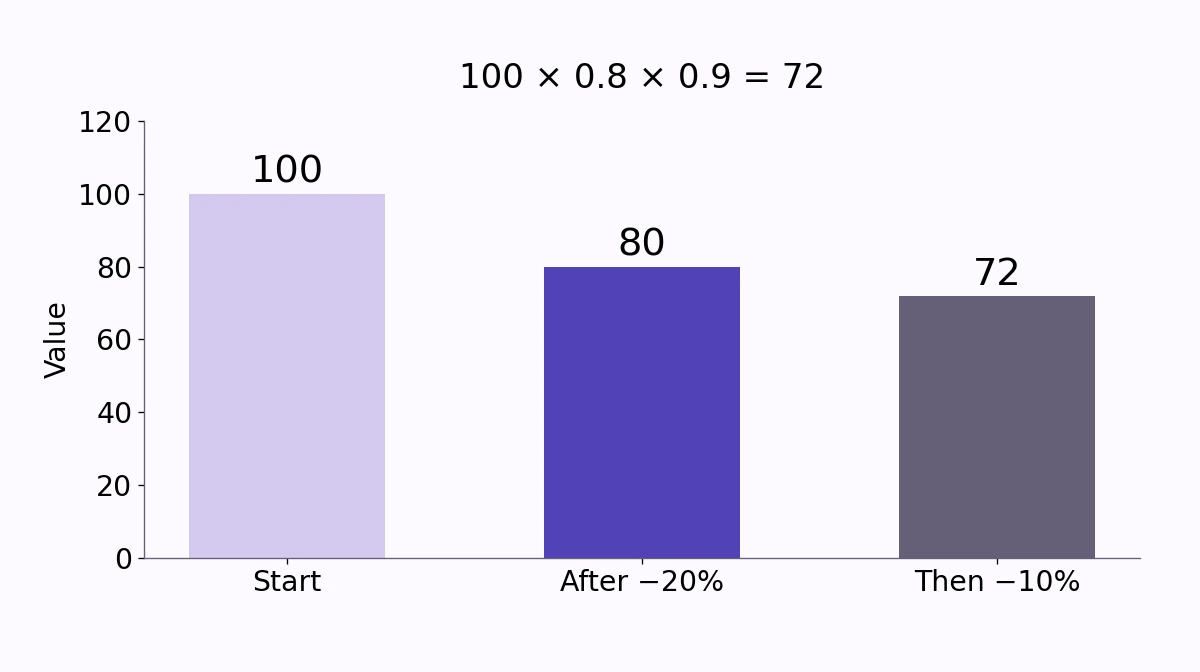
A price falls from $100 by 20%, then the reduced price falls by another 10%. The final price is $72, giving a total decrease of 28%. Adding the two discount rates would give the wrong result because the second percentage uses a different base.
Successive changes multiply the remaining proportions. Keeping track of the quantity after each step prevents a percentage shortcut from answering the wrong question.
Write down the base at each step
The first discount removes 20% of $100, or $20. That leaves $80. The second removes 10% of $80, or $8, leaving $72. Together, the reductions remove $28 from the original $100.
If the second reduction were instead defined as 10% of the original $100, it would remove $10 and the final price would be $70. That is a different instruction. The words describing the base determine the calculation.
Multiply the factors that remain
A 20% decrease retains 80%, represented by the factor 0.8. A 10% decrease retains 90%, represented by 0.9. The combined factor is \(0.8\times0.9=0.72\).
The retained share is therefore 72% of the starting value, and the removed share is \(100\%-72\%=28\%\). For decrease rates a and b expressed as fractions, the total decrease is \(1-(1-a)(1-b)=a+b-ab\).
The product ab is 0.02 in this example. That is the two-percentage-point difference between adding 20% and 10% and calculating their successive effect. It is also true that 20% of 10% is 2%; that product alone is not the total reduction from two successive discounts.
Equal increases and decreases do not cancel
Start at 100, increase by 20%, then decrease by 20%. The intermediate value is 120 and the final value is 96, since \(1.2\times0.8=0.96\). The decrease uses a larger base than the original increase.
To reverse a 20% decrease, a value of 80 must increase by 20 to return to 100. The required rate is \(\frac{20}{80}=25\%\). The original percentage and the reversing percentage have different denominators.
Separate percentages from percentage points
A rate moving from 20% to 30% rises by 10 percentage points. Relative to its original value, the rate rises by \(\frac{30-20}{20}=50\%\). Neither number describes two successive discounts.
For a sequence of ordinary percentage changes, begin with a concrete starting value or multiply factors of the form \(1+\text{rate}\). Preserve signs and keep full precision until the final display. MathBlog’s percentage-of-a-percentage calculator handles the product of two percentages; name the desired quantity before interpreting its output.