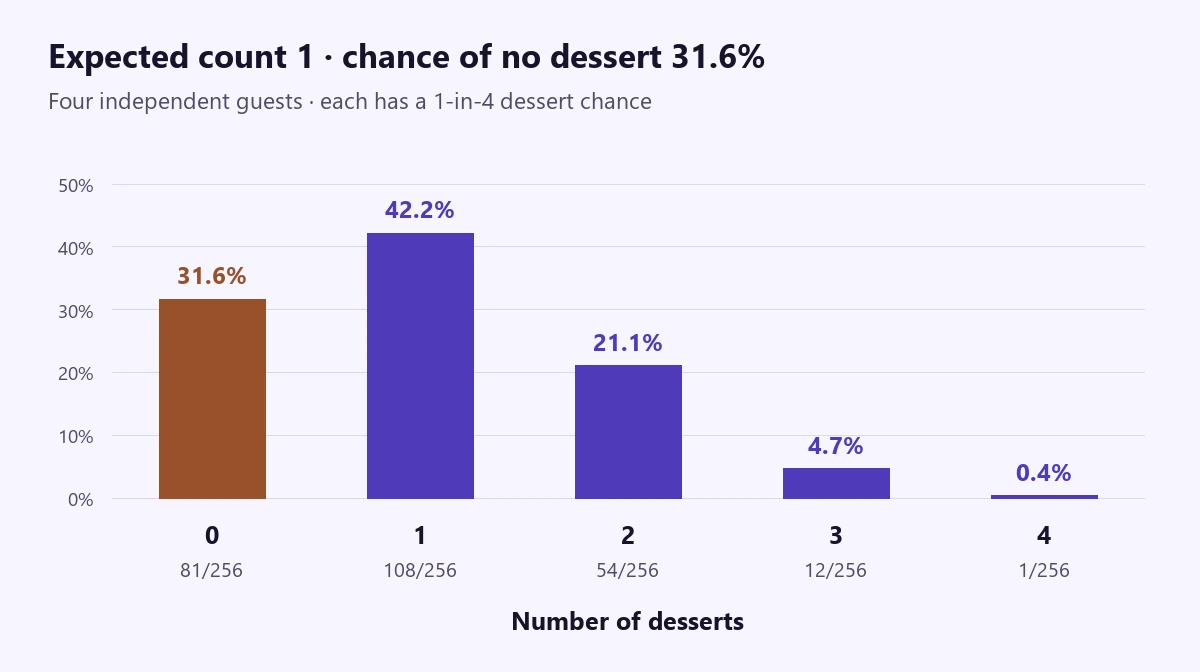
Four guests each have a one-in-four chance of bringing a dessert to a potluck. The expected number of desserts is one. If their choices are independent, the chance that nobody brings dessert is about 31.6%.
In this hypothetical model, each guest brings one dish, which is either a dessert or something savory. The expected count describes an average across repeated potlucks under the same conditions. At this potluck, anywhere from zero to four desserts can arrive.
Find the expected dessert count
Each guest contributes either one dessert or zero. Their expected contribution is \(1\times\frac14+0\times\frac34=\frac14\). Add the four expected contributions.
\[E(X)=4\times\frac14=1,\]
where \(X\) is the number of desserts. Some potlucks produce no desserts and others produce several. The probability-weighted average of all five possible counts is one.
Multiply the four chances of no dessert
Each guest has a \(\frac34\) chance of bringing a savory dish. With independent choices, all four must do so for the table to have no desserts. Multiply those four probabilities.
\[P(X=0)=\left(\frac34\right)^4=\frac{81}{256}\approx31.6\%.\]
The chance of at least one dessert is the remaining probability.
\[P(X\ge1)=1-\frac{81}{256}=\frac{175}{256}\approx68.4\%.\]
Independence lets you multiply the same probability at each step. The marble-drawing example shows how the calculation changes when an earlier outcome affects a later one.
Exactly one dessert is another event
For exactly one dessert, choose which of the four guests brings it. That guest has probability \(\frac14\) of bringing dessert, and the other three each have probability \(\frac34\) of bringing something savory.
\[P(X=1)=4\times\frac14\left(\frac34\right)^3=\frac{108}{256}\approx42.2\%.\]
The full count follows a binomial distribution with four trials and success probability \(\frac14\). Its probabilities are below.
| Desserts | Exact probability | Approximate percentage |
|---|---|---|
| 0 | 81/256 | 31.6% |
| 1 | 108/256 | 42.2% |
| 2 | 54/256 | 21.1% |
| 3 | 12/256 | 4.7% |
| 4 | 1/256 | 0.4% |
Check how the guests make their choices
Coordination can change the chance of an empty dessert table. Suppose all four guests follow a single shared choice that calls for dessert one-quarter of the time. Then either all four bring dessert or all four bring savory dishes. Each guest still has a one-in-four dessert chance, and the expected total is still one. The chance of no dessert is now 75%.
For a real potluck, a sign-up list supplies information about the dishes people plan to bring. The 31.6% calculation applies to the stated independent-choice model.


