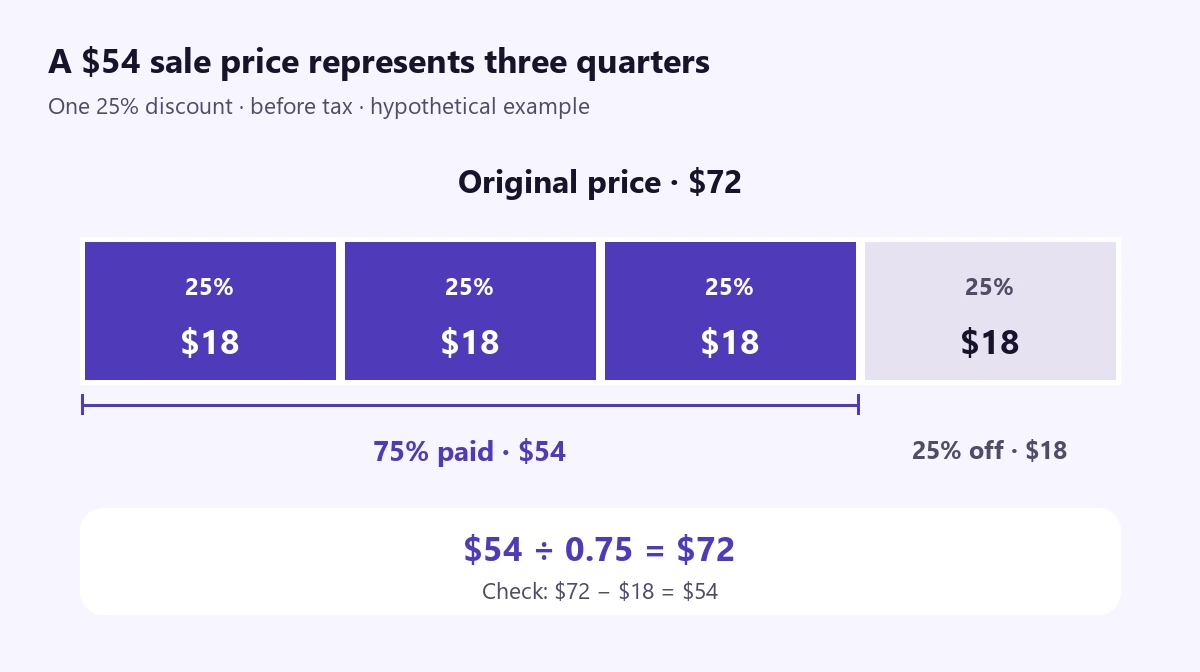
A sale price of $54 after a 25% discount means the original price was $72. The remaining $54 represents 75% of the original price, so divide it by 0.75.
In this hypothetical example, the price has one percentage discount applied before tax. Start with the share of the original price that remains after that discount.
Find the percentage still being paid
A 25% discount removes one-quarter of the original price. The remaining three-quarters cost $54. Each quarter is therefore worth \(54\div3=18\) dollars, and all four quarters are worth \(4\times18=72\) dollars.
You can write the same reasoning as an equation. Let \(P\) be the original price in dollars.
\[0.75P=54\qquad P=\frac{54}{0.75}=72.\]
Check the result by applying the discount again. Twenty-five percent of $72 is $18. Subtracting $18 from $72 leaves the stated sale price of $54.
Why adding 25% gives a different result
A 25% increase on $54 adds $13.50 and gives $67.50. This calculation uses the smaller sale price as its base. The original discount removed $18, so recovering the original price requires adding $18 to $54.
That $18 is one-third of $54, or \(33\frac{1}{3}\%\). A percentage change depends on the amount it starts from. The example of successive percentage changes shows how changing the base affects a second calculation.
Divide by the fraction that remains
For a sale price \(S\) and a discount rate \(r\) written as a decimal, the remaining fraction is \(1-r\). The relationship and its reverse are
\[S=P(1-r),\qquad P=\frac{S}{1-r}.\]
The formula applies to a single discount with \(0\le r<1\). For example, 10% off leaves 0.90 of the original price. A $54 sale price would then come from $60. With 40% off, 0.60 remains, and the same $54 sale price would come from $90.
You can also enter 54 as 75% of an unknown value in the percentage calculator. For a 25% discount, the percentage entered is the 75% that remains.
Check what the stated price includes
Use the price after the percentage discount and before any separately added taxes or fees. If several discounts were applied, work through their actual order and rates. A sale price rounded to cents may recover only an approximate original price when you divide.
At 100% off, the sale price is zero for every positive original price. The formula would divide by zero, and the original amount cannot be recovered from that sale price and rate alone.