Try solving \(\sqrt{x+5}=x-1\) by squaring both sides. The resulting quadratic gives \(4\) and \(-1\). Only \(4\) works in the equation you started with.
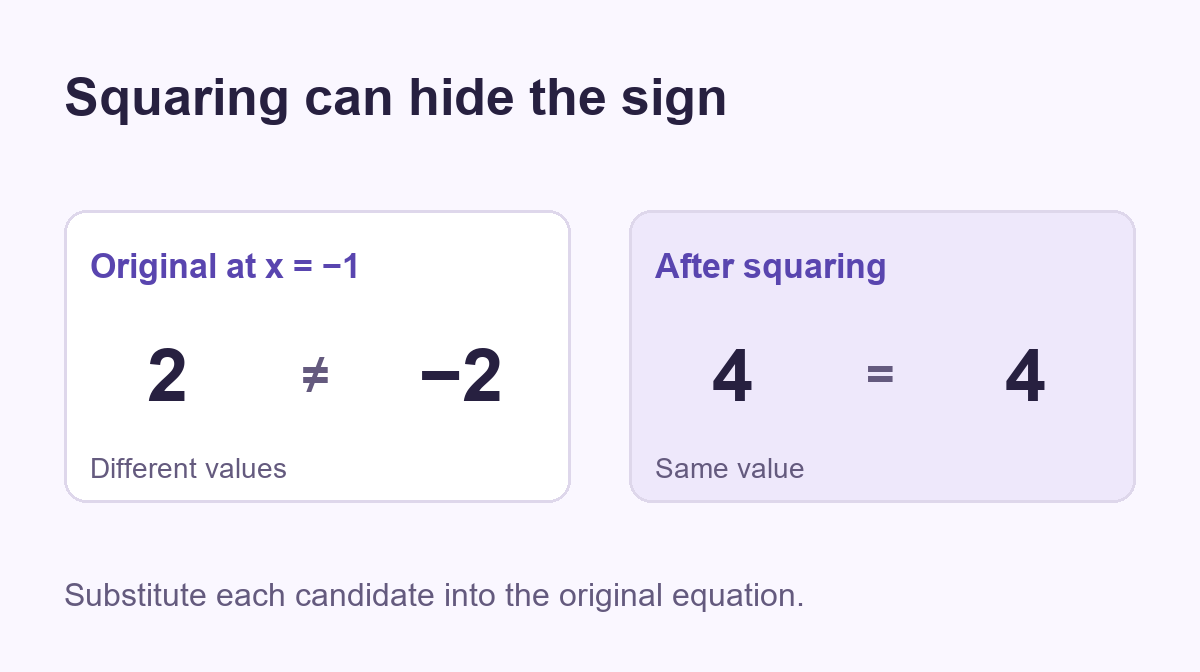
At \(x=-1\), the left side is \(2\) and the right side is \(-2\). Squaring turns both into \(4\), so the squared equation accepts a value that fails the original.
Square both sides and find the candidates
Work with real numbers. The radicand must satisfy \(x+5\geq 0\). The square root is nonnegative, so the right side also needs \(x-1\geq 0\). Together these conditions require \(x\geq 1\).
Squaring removes the square root.
\[x+5=(x-1)^2=x^2-2x+1.\]
Move everything to one side and factor the quadratic.
\[x^2-3x-4=0 \quad\Longrightarrow\quad (x-4)(x+1)=0.\]
The candidates are \(x=4\) and \(x=-1\). You can also get them with the quadratic formula. Either way, check them in the original equation.
Check both values before keeping an answer
| Candidate | Left side | Right side | Result |
|---|---|---|---|
| \(4\) | \(\sqrt{9}=3\) | \(4-1=3\) | Solution |
| \(-1\) | \(\sqrt{4}=2\) | \(-1-1=-2\) | Extraneous solution |
The squared equation checks whether the two sides have the same magnitude. The original asks whether the values are equal. Checking \(x\geq 1\) already rules out \(-1\), and substitution confirms \(4\).
Keep the original restrictions with your work when you square an equation. At the end, substitute each candidate into the equation you started with.