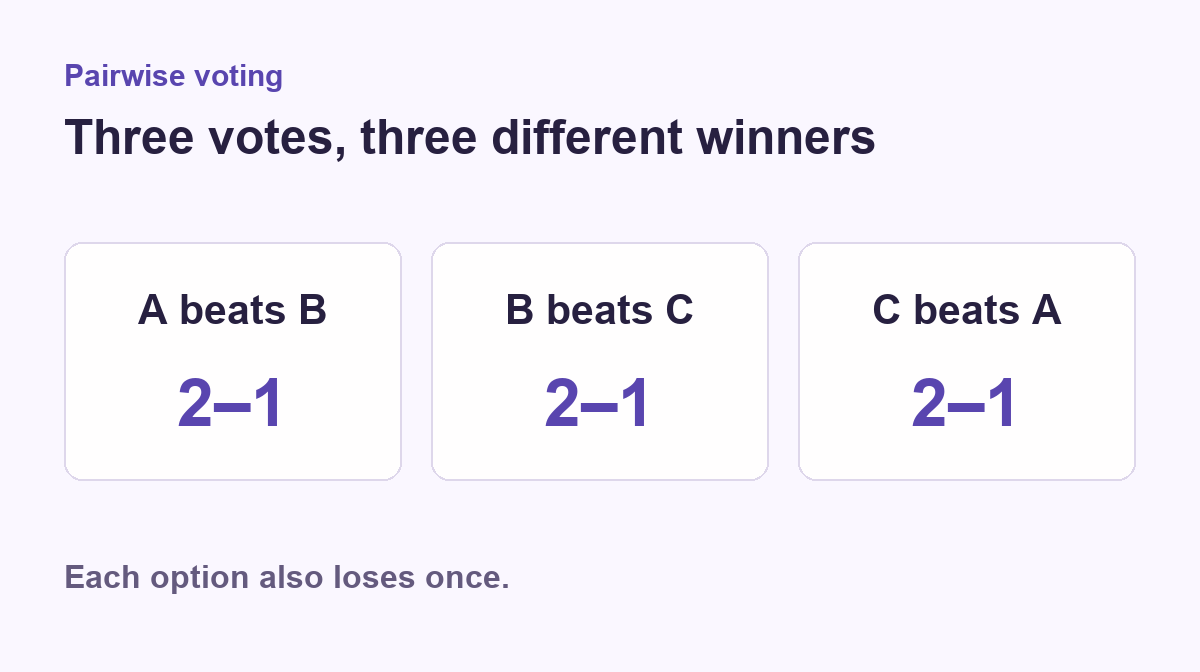
Three members of a library committee rank three workshop proposals. A beats B by two votes to one. B beats C by the same margin. C then beats A, also by two votes to one.
Each workshop wins one head-to-head vote and loses another. The results form a cycle, even though every voter has put the three proposals in a clear order.
Count the three comparisons
| Voter | First | Second | Third |
|---|---|---|---|
| 1 | A | B | C |
| 2 | B | C | A |
| 3 | C | A | B |
To compare two workshops, look at which one each voter ranked higher. A voter can prefer A to B even if C is that voter’s first choice.
- A beats B. Voters 1 and 3 rank A higher. Voter 2 ranks B higher.
- B beats C. Voters 1 and 2 rank B higher. Voter 3 ranks C higher.
- C beats A. Voters 2 and 3 rank C higher. Voter 1 ranks A higher.
Why the three majorities form a cycle
On voter 1’s ballot, A ranks above B and B ranks above C, so A ranks above C. A group can produce a different result because the people making up the majority change from one comparison to the next. Voter 3 supplies a vote for A against B and a vote for C against A.
An option that wins against every other option one-on-one is called a Condorcet winner. There is no such winner in this example. In a sequential vote that keeps the winner of the first matchup, the order can decide the outcome. Compare A and B first and C wins the second matchup. Compare B and C first and A wins the second matchup.
If a group plans to use head-to-head votes, it helps to agree in advance on how to handle a cycle. The ranked ballots alone give you the three pairwise results. The rule determines how those results become a decision.