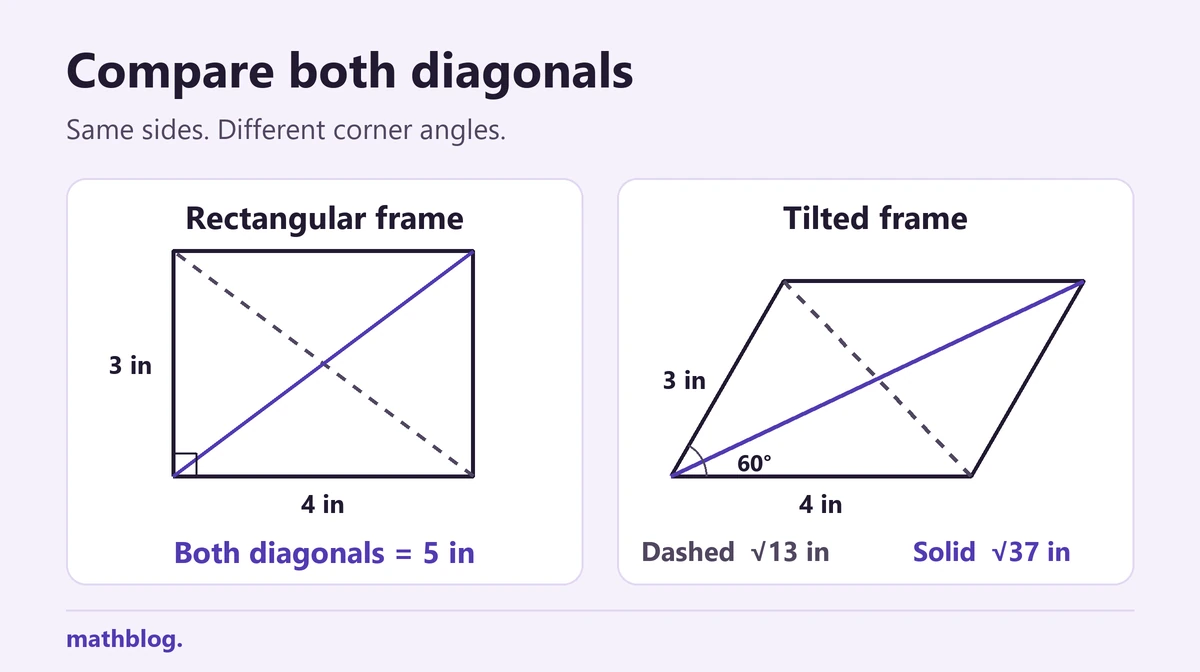
A frame made from two 3-inch pieces and two 4-inch pieces can tilt without changing the lengths of its sides. With right-angle corners, both diagonals measure 5 inches. Tilt the frame so one corner measures \(60^\circ\), and one diagonal shrinks to about 3.61 inches while the other grows to about 6.08 inches.
This check works when the frame is a parallelogram, with each pair of opposite sides parallel. Measure from corner to opposite corner in both directions and compare the lengths.
Start with the rectangular frame
Each diagonal of a 3-by-4 rectangle is the hypotenuse of a right triangle with legs of 3 and 4 inches. The Pythagorean theorem gives \(\sqrt{3^2+4^2}=5\) inches for both diagonals.
See what changes at a 60-degree corner
The tilted frame has corners of \(60^\circ\) and \(120^\circ\). The shorter diagonal joins the ends of two sides that meet at \(60^\circ\). The longer diagonal lies opposite a \(120^\circ\) corner. The law of cosines gives the length across each angle.
\[d_{\mathrm{short}}^2=3^2+4^2-2(3)(4)\cos 60^\circ=13\]
\[d_{\mathrm{long}}^2=3^2+4^2-2(3)(4)\cos 120^\circ=37\]
The cosine is \(\frac12\) at \(60^\circ\) and \(-\frac12\) at \(120^\circ\). One squared length is 12 below 25, and the other is 12 above it. Take the square roots to get the lengths in inches.
Check the shape before trusting a match
In a parallelogram, the adjacent angles are supplementary. Their cosines have opposite signs, so the two diagonals can be equal only when the cosine is zero. That happens when the corners are \(90^\circ\).
On a physical frame, measure between the same kind of corner point in both directions. If the frame is a parallelogram and the diagonals differ by more than you can attribute to measurement error, adjust the corners and measure again. For a four-sided shape with unknown sides, check the shape first. An isosceles trapezoid, for example, can have matching diagonals and slanted sides.