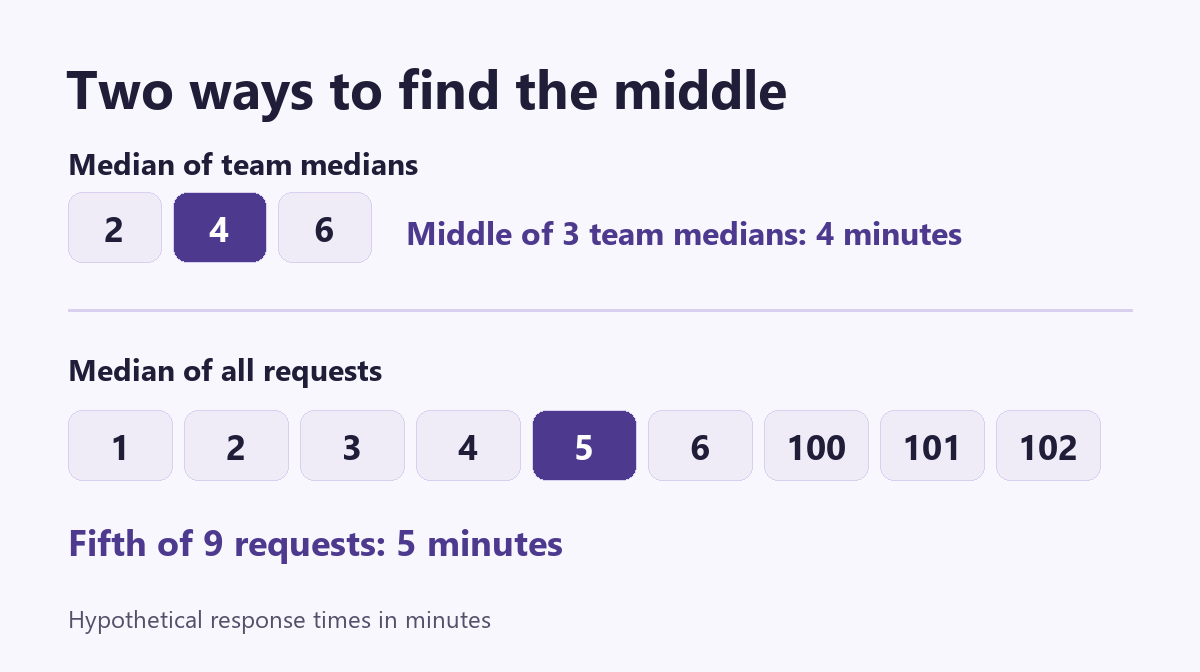
Three service teams each handle three requests. Their median response times are 2, 4, and 6 minutes. The middle of those three medians is 4 minutes. Sort all nine response times together, though, and the middle request took 5 minutes.
Both results answer a real question. Four minutes is the median team result. Five minutes is the median response time for a request across all three teams. Equal team sizes still leave room for those numbers to differ.
Find the middle of all nine requests
These fictional response times are already sorted within each team.
| Team | Response times in minutes | Team median |
|---|---|---|
| A | 1, 2, 100 | 2 |
| B | 3, 4, 101 | 4 |
| C | 5, 6, 102 | 6 |
For an odd number of observations, the median is the middle value after sorting. With nine requests, that is position \((9+1)/2=5\). The pooled order is 1, 2, 3, 4, 5, 6, 100, 101, 102. Four requests took less than five minutes and four took longer.
Each team median uses only three requests. Keeping those three medians drops six response times, including the 5 from Team C. The middle of the remaining values is 4. In the full data, only four requests took 4 minutes or less, so the fifth request has to lie above 4.
The same team medians can hide a different pooled median
Imagine a second set of requests. Team A has 0, 2, 3 minutes. Team B has 1, 4, 5. Team C has 2, 6, 7. The team sizes and medians are still the same. The pooled order is now 0, 1, 2, 2, 3, 4, 5, 6, 7, so the median request took 3 minutes.
Both sets would produce the same team summary. The pooled medians in these examples are 3 and 5. Weighting the team medians by their request counts cannot recover what the summary dropped. Here the weights would be identical in both sets.
Choose the data that answer your question
For the typical request across teams, combine the original response times and find their median. Exact counts for each distinct response time also work because they preserve the order and frequency of the values. A report with only team medians and sample sizes cannot generally reconstruct that result.
If the question is about the typical team’s reported median, using one median per team makes sense. Label the result accordingly so a reader can tell whether each team or each request gets one place in the calculation.