Two invoice lists can contain the same number of rows and add up to the same amount even when an invoice is missing. If an export leaves out an $87.50 invoice and repeats another $87.50 invoice, the total stays the same. So does the row count.
To see what happened, compare the invoice IDs in the export with the IDs in the register it came from. The total tells you how much was recorded. The IDs tell you which invoices were recorded.
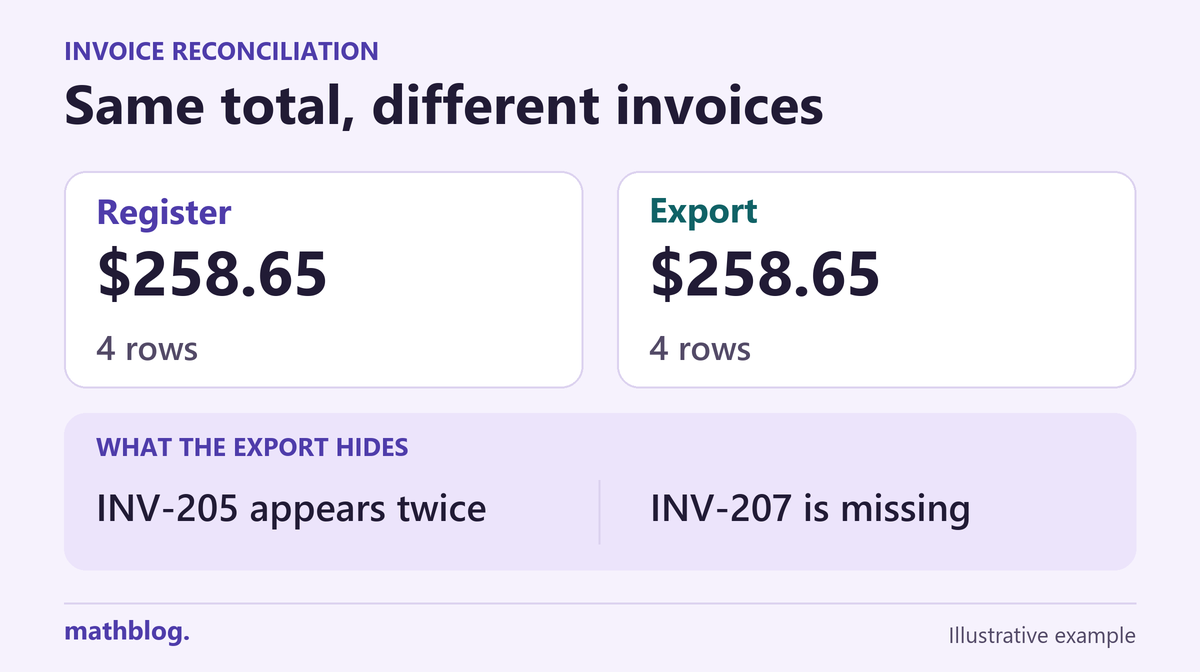
Four rows and $258.65 on both lists
Suppose a shop keeps a register with one row per invoice. The table compares that register with an export for the same period. The invoice IDs and amounts are hypothetical.
| Invoice in register | Register amount | Invoice in export | Export amount |
|---|---|---|---|
| INV-204 | $52.40 | INV-204 | $52.40 |
| INV-205 | $87.50 | INV-205 | $87.50 |
| INV-206 | $31.25 | INV-206 | $31.25 |
| INV-207 | $87.50 | INV-205 | $87.50 |
| Total | $258.65 | Total | $258.65 |
INV-205 and INV-207 legitimately have the same amount in the register. In the export, the second INV-205 adds exactly what the missing INV-207 would have contributed. The export therefore passes both summary checks while representing only three distinct invoices.
Check which IDs appear and how often
For an export that should have one row per invoice, count the occurrences of each invoice ID. INV-205 should appear once but appears twice. INV-207 should appear once but appears zero times. Also look for export IDs that do not appear in the register. A distinct-ID count can flag a mismatch, but the individual counts show which records need investigation.
After confirming that every expected ID occurs exactly once, compare the amounts for the matching IDs. Two amounts could be swapped between invoices while both the grand total and all the ID counts still agree.
Start by confirming that both lists cover the same period and use the same inclusion rules. If the export contains one row per invoice line item, repeated invoice IDs are expected. In that case, compare line items using their own identifiers or aggregate the lines before comparing invoice totals. If a one-row-per-invoice export has an unexpected repeat, look for its cause in the source or export rather than deleting one of the rows on sight.
Further reading
- UK Government Digital ServiceThe Government Data Quality FrameworkRead how completeness and uniqueness measure different aspects of a dataset.
- U.S. Government Accountability OfficeAssessing Data ReliabilityAppendix III gives examples of checks for duplicate identifiers and missing records.
- MathBlogHow to Match Two Lists in Python with pandasWork through an example that matches records by ID and shows which rows fail to match.