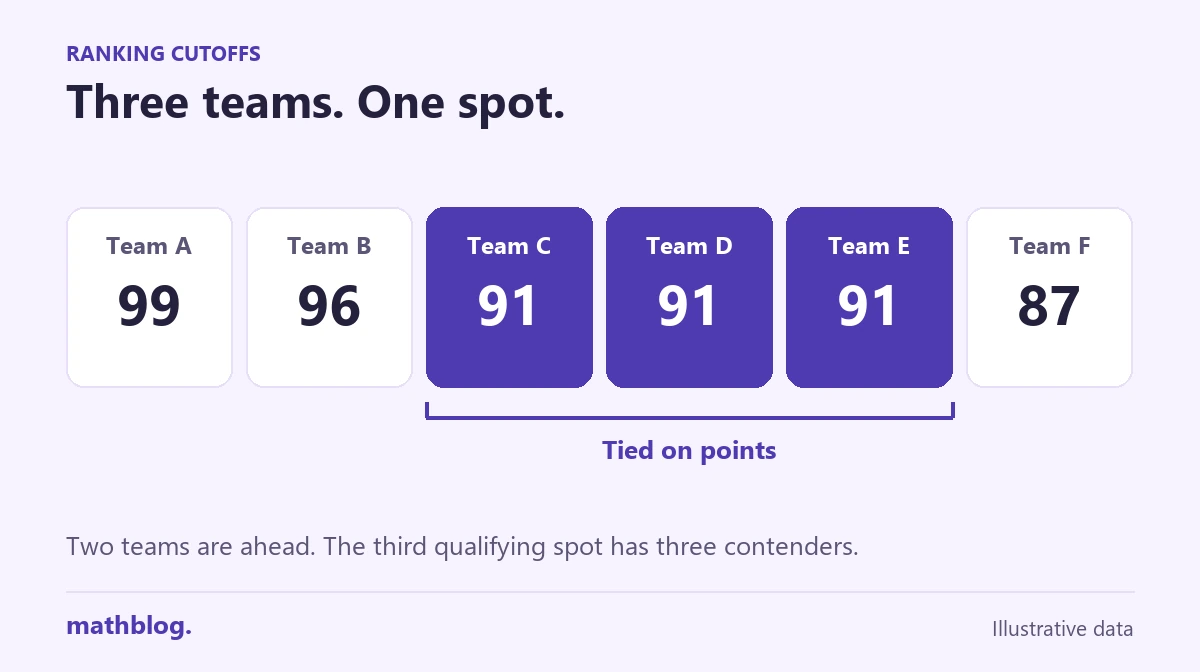
Three teams are tied at 91 points, and there is one seat left in the final. The leaderboard can tell you which teams are tied. Filling the seat takes a rule the leaderboard alone cannot supply.
Consider a fictional weekend quiz that advances three teams. Teams A and B finish ahead of the field. Three more teams earn the same score at the cutoff, and the organizers have to decide what “the top three” means.
A tied rank can cover several positions
One common way to number a leaderboard gives equal scores the same rank. Count the teams with a strictly higher score, then add one. The table uses that convention.
| Team | Points | Rank |
|---|---|---|
| A | 99 | 1 |
| B | 96 | 2 |
| C | 91 | 3 |
| D | 91 | 3 |
| E | 91 | 3 |
| F | 87 | 6 |
Teams C, D, and E each have two teams ahead of them, so each is third. Team F has five teams ahead of it, which puts it sixth. The jump from third to sixth accounts for all three entries with 91 points. Repeated values still occupy separate places in an ordered list, the same detail that matters when you find the middle of a data set.
Decide what the third seat means
Suppose the room can accommodate extra teams. The organizers might admit everyone whose score reaches the third place cutoff. The first two teams qualify, all three teams at 91 qualify, and the final has five teams. The policy keeps equal scores together and allows the size of the field to vary.
With exactly three seats, the organizers need a way to choose among C, D, and E. A published rule might use the time taken to finish the last qualifying round. If those teams took 72, 65, and 69 seconds respectively, Team D gets the seat. The published leaderboard can still show all three teams tied on points and identify Team D as the qualifier under the time rule.
The rule should also cover an equal time. A short extra question or a draw can settle a tie that survives the secondary criterion. If the organizers choose a uniform draw from three tied teams for one seat, each team has a \(\frac{1}{3}\) chance of advancing.
Tell readers where the boundary is
A table can look like it settles the issue simply because the rows have an order. If the three teams on 91 were listed alphabetically, Team C would appear first in that group. The alphabetical position has meaning only if the rules give it meaning.
Give the cutoff a clear label and say how ties work before publishing the list. “Three seats, with completion time deciding equal scores” describes a different result from “Everyone at the third place score advances.” Readers can then check the outcome against the rule using the same table.