A calculator can produce more decimal places than your measurements can support. Multiply 18.7 by 4.3 and you get 80.41. The arithmetic is right. Whether all those places belong in a measurement report is a separate question.
Imagine measuring a small rectangular piece of card. You record a length of 18.7 cm and a width of 4.3 cm, then calculate its area. The display has created hundredths of a square centimeter from inputs written only to tenths of a centimeter. It has not made another measurement.
The product is exact for the numbers you entered
The decimal product is \(18.7\times4.3=80.41\). If those two inputs were exact mathematical values, there would be no measurement issue to resolve. But a recorded reading can summarize more information than its written digits reveal.
Suppose, just for this example, the only information lost was rounding. Both positive readings were rounded to the nearest 0.1 cm, with exact halfway cases rounded up. The pre-rounding readings then fit these bins:
| Recorded reading | Possible pre-rounding reading |
|---|---|
| 18.7 cm | 18.65 cm ≤ length < 18.75 cm |
| 4.3 cm | 4.25 cm ≤ width < 4.35 cm |
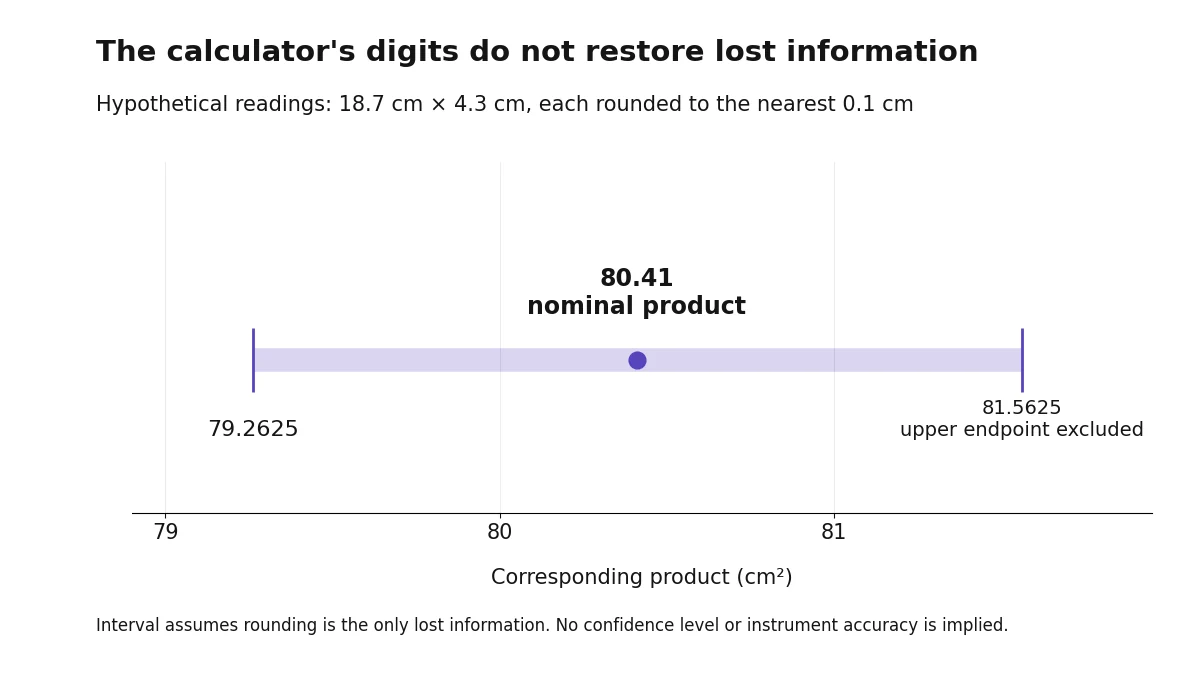
All these lengths are positive, so the smallest corresponding product uses both lower endpoints: \(18.65\times4.25=79.2625\) cm². Products can approach \(18.75\times4.35=81.5625\) cm² from below. The nominal 80.41 cm² is inside that range, but the input records do not pick out that exact area.
This interval concerns the readings before rounding. It does not cover a crooked ruler, calibration error, a bent card, or a different definition of the rectangle’s edges. Those effects need their own information. Calling the interval a 95% confidence interval would add a probability claim that we have not established.
Addition and division ask different rounding questions
Introductory measurement rules often use the coarsest decimal place for addition and subtraction, but the fewest significant digits for multiplication and division. Those are useful reporting conventions when a problem calls for them; they are not a complete uncertainty model.
For example, \(12.11\,\mathrm{cm}+18.0\,\mathrm{cm}\) gives 30.11 cm. Under the addition convention, the final report is 30.1 cm because one input stops at tenths. By contrast, \(\frac{12.11\,\mathrm{cm}}{18.0\,\mathrm{cm}}\) is approximately 0.672777…; the division convention gives 0.673, with three significant digits. The units cancel in the ratio.
An exact count, such as three objects, is different from a measured value. Writing the count with one digit does not turn it into a one-significant-digit measurement. Start by identifying what each input means, rather than counting every visible digit indiscriminately.
Keep working digits until the final report
Shortening the final display does not mean shortening every intermediate calculation. Suppose a report needs a sum rounded to hundredths. Adding \(1.244+1.244\) first gives 2.488, which rounds to 2.49. Rounding each input first gives \(1.24+1.24=2.48\). The order has changed the answer.
Keep adequate working precision, then apply the chosen reporting rule at the end. NIST’s calibration guidance specifically cautions against rounding intermediate uncertainty calculations. A calculator’s longer result can therefore be useful internally even when you should show a shorter number to a reader.
Choose the report from the evidence
For the card, a casual description such as “about 80 cm²” avoids advertising a settled hundredth. If the limits matter, give the assumptions and the interval instead. If you have evaluated measurement uncertainty, report that uncertainty and its meaning, not a guessed error bar inferred from the display.
The practical habit is to keep the original readings, their units, and any instrument or procedure information; calculate without unnecessary early rounding; then decide which detail the report can justify. Our rounding guide covers the number-changing step. The measurement record tells you which step is appropriate.
Further reading
- NISTRounding expanded uncertainties and calibration valuesGuidance on final reporting and why intermediate rounding can introduce errors.
- NISTBasic definitions of measurement uncertaintySee why a measurement model must include the process and relevant inputs.
- NISTReporting uncertaintyUnderstand why a probability interpretation needs an explicit basis.