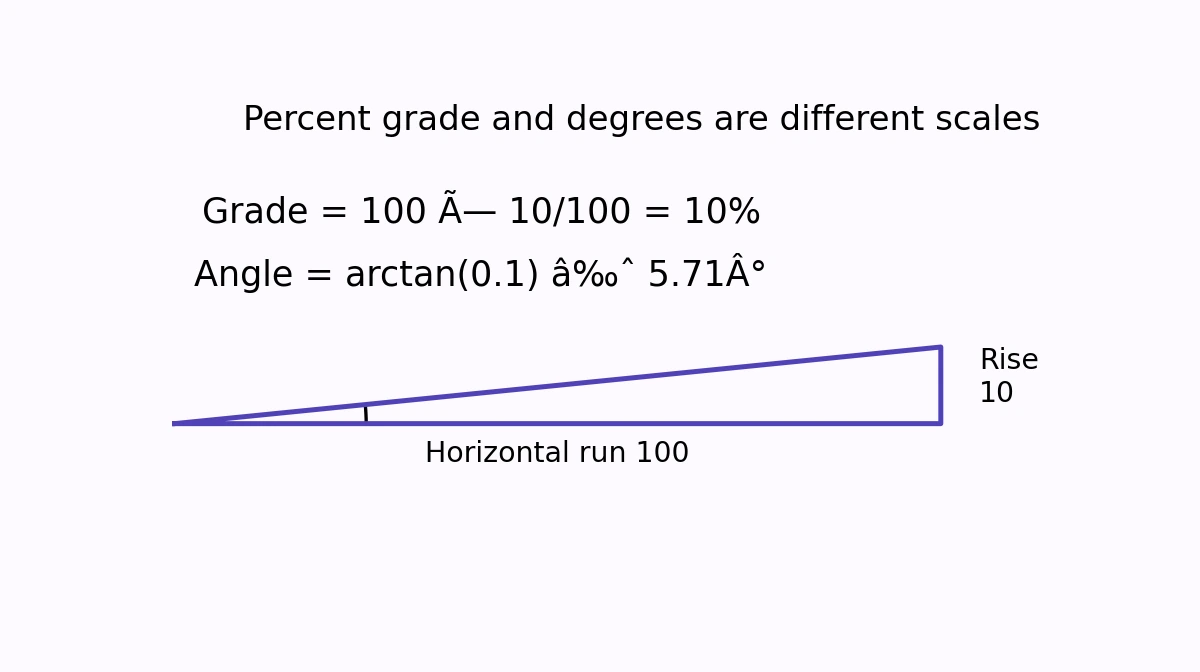
A road that rises 10 feet for every 100 feet of horizontal distance has a 10% grade. Its angle above the horizontal is about 5.71°, not 10°. Percent grade and degrees describe the same incline using different quantities.
The distinction matters whenever a slope is read from a map, a diagram, or a specification. First determine what the denominator measures.
Grade uses horizontal run
Percent grade is \(100\times\frac{\text{rise}}{\text{horizontal run}}\). In the example, \(100\times\frac{10}{100}=10\%\). The run is the horizontal leg of a right triangle, not the distance traveled along the sloping surface.
The sloping side is \(\sqrt{100^{2}+10^{2}}\approx100.50\) feet. Using \(\frac{10}{100.50}\) instead would give about 9.95%. That ratio compares rise with the sloping length; it is not the grade definition used here.
Use the tangent for the angle
For inclination θ above the horizontal, \(\tan(\theta)=\frac{\text{rise}}{\text{run}}\). A 10% grade therefore has \(\tan(\theta)=0.10\), so \(\theta=\arctan(0.10)\approx5.7106^{\circ}\).
In the other direction, a 10° angle gives percent grade \(100\tan(10^{\circ})\approx17.63\%\). A calculator in radian mode needs the angle converted or a function that explicitly takes degrees.
A 100% grade is another useful anchor. Equal rise and run give \(\tan(\theta)=1\), which corresponds to 45°. As the angle approaches 90°, the horizontal run approaches zero relative to the rise and the grade grows without bound. A vertical line has undefined finite grade.
The sign and direction belong in the description
A positive grade describes rising elevation as the chosen horizontal coordinate increases. Reversing direction changes the sign. The same stretch can be an uphill route in one direction and a downhill route in the other.
For an uneven road, total rise divided by total horizontal run is an average slope between endpoints. It does not identify the steepest segment, and it can hide intermediate climbs and descents.
Read the label before converting
“Slope 1:10” can also be ambiguous without a convention. If it means one unit of rise to ten units of horizontal run, it is a 10% grade. If a drawing defines a different ratio, use that drawing’s definition rather than assuming.
These examples explain the geometry; they are not an assessment of a road’s safety or accessibility. The quantities can be checked with the same rise-over-run calculation used for a straight line. State the units and horizontal reference before attaching a percentage or an angle.