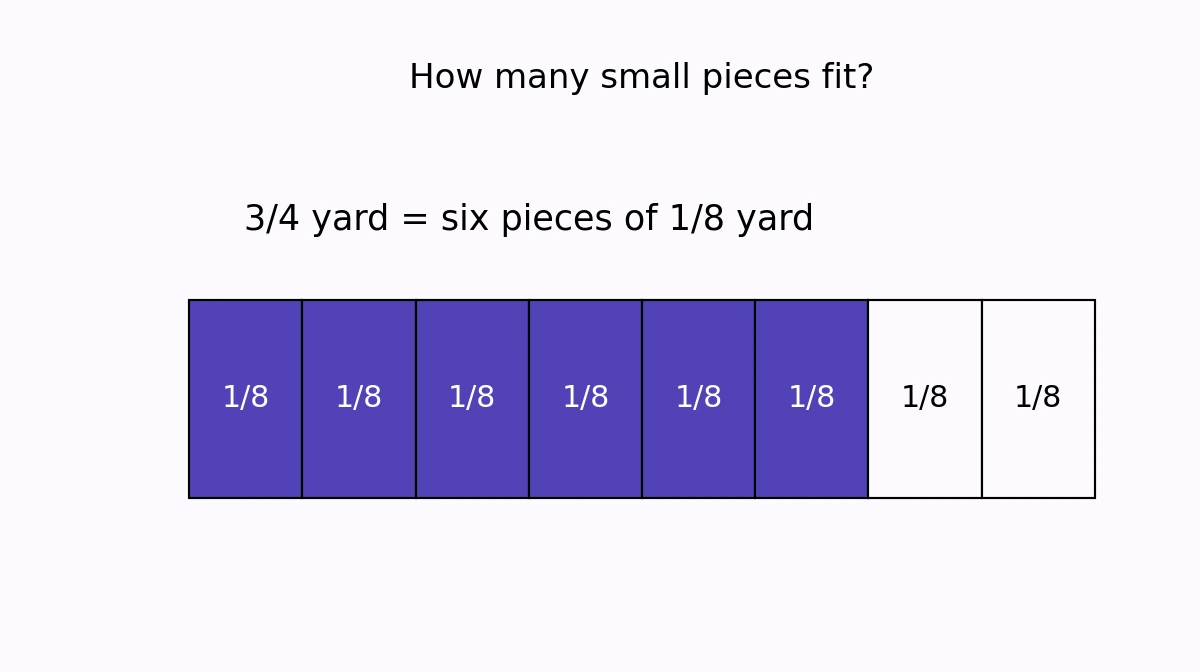
You have three quarters of a yard of ribbon. Each decoration needs one eighth of a yard. Dividing tells you how many decorations you can make: \(\frac{3}{4}\div\frac{1}{8}=6\). The answer is larger than either fraction because the question counts small pieces.
The familiar idea that division makes numbers smaller works for many early whole-number examples. It is not a rule for all division. The size and sign of the divisor matter.
Ask what one unit of the answer represents
In this problem, the starting quantity is measured in yards. The divisor is yards per decoration. Dividing yards by yards per decoration leaves a count of decorations. Six is not a longer piece of ribbon than three quarters of a yard; it is a different kind of quantity.
Convert the available ribbon into eighths: \(\frac{3}{4}=\frac{6}{8}\). There are six pieces of length \(\frac{1}{8}\) in that amount. Multiplying the check back gives \(6\times\frac{1}{8}\,\text{yard}=\frac{3}{4}\,\text{yard}\).
Why the reciprocal works
For a nonzero divisor \(\frac{c}{d}\), multiplying by \(\frac{d}{c}\) reverses multiplication by \(\frac{c}{d}\). To solve \(q\times\frac{c}{d}=\frac{a}{b}\), multiply both sides by \(\frac{d}{c}\). The result is \(q=\frac{a}{b}\times\frac{d}{c}\).
Our example becomes \(\frac{3}{4}\times\frac{8}{1}=\frac{24}{4}=6\). The reciprocal is useful because it solves the original multiplication equation. It is not an instruction to flip every fraction in sight.
For comparison, \(\frac{3}{4}\div2=\frac{3}{8}\). Dividing the ribbon equally between two people produces a smaller share. Division can answer a sharing question or a how-many-groups question; the units clarify which question you asked.
The divisor predicts the direction
For a fixed positive number, dividing by a positive value less than one gives a larger numerical result. Dividing by one leaves it unchanged. Dividing by a positive value greater than one gives a smaller result.
That statement needs its positive-number conditions. Negative divisors also change the sign, and phrases such as “larger” need care when negative values are involved. Zero is another separate case: zero divided by a nonzero number is zero, while division by zero is undefined.
Use an estimate before calculating
One eighth is a small portion of a yard, and three quarters is six times as long. An answer below one would mean that even one decoration could not be completed, which conflicts with the lengths in the question.
Write the units, estimate the number of groups, then calculate and multiply back. For a refresher on equivalent forms, see MathBlog’s guide to fractions. The arithmetic should preserve the meaning of the question, not replace it.


