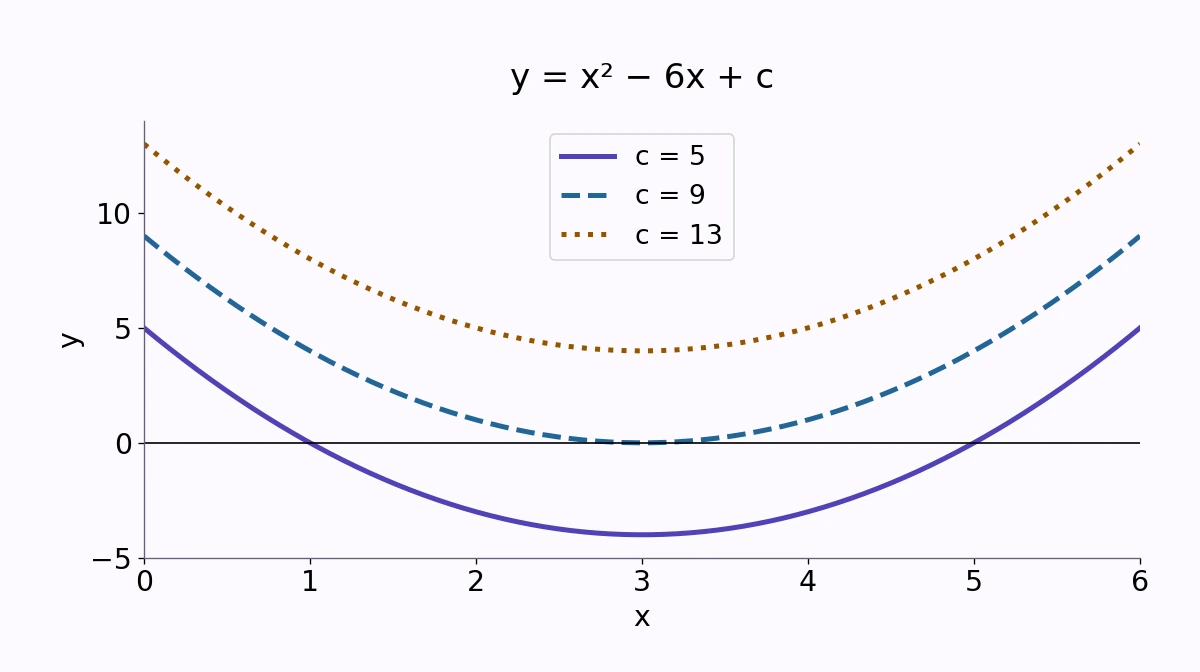
The graphs of \(y=x^{2}-6x+5\), \(y=x^{2}-6x+9\), and \(y=x^{2}-6x+13\) have the same shape. Moving the constant term shifts the parabola vertically. Those shifts change whether the curve crosses, touches, or misses the horizontal axis.
Before calculating roots, a graph can suggest how many real solutions to expect. Algebra can then confirm whether that visual impression is exact.
Find the vertex’s position
Completing the square rewrites the three functions as \((x-3)^{2}-4\), \((x-3)^{2}\), and \((x-3)^{2}+4\). Each opens upward with axis of symmetry \(x=3\), but their minimum values are −4, 0, and 4.
The first curve must cross \(y=0\) on both sides of its minimum. It has roots \(x=1\) and \(x=5\). The second only touches at \(x=3\), a repeated root. The third stays above the horizontal axis and has no real root.
The discriminant confirms the picture
For \(ax^{2}+bx+c=0\) with a nonzero, the discriminant is \(D=b^{2}-4ac\). In our three examples it is 16, 0, and −16.
A positive D gives two distinct real roots. Zero gives one repeated real root. A negative D gives a complex conjugate pair, with no real x-intercept. These conclusions come from the sign of the quantity inside the quadratic formula’s square root.
Notice what the graph does not show as real points: the last equation has complex roots \(3\pm2i\). “No real solution” is more precise than saying that it has no solution without naming the number system.
A visible gap can be misleading
A plotted image has finite resolution. The curve \(y=(x-3)^{2}-0.000001\) has roots 2.999 and 3.001. A broad plot might make it look as though it only touches the axis.
Likewise, a graphing window can hide one or both crossings outside the displayed range. A smooth curve on a screen is evidence about a function, not a substitute for checking the equation and its domain.
Read more than the roots
The sign of a tells you the opening direction. The y-intercept is c. The symmetry line is \(x=-\frac{b}{2a}\). Together, these features help catch errors such as a missing negative sign before you use the full formula.
For a downward-opening parabola, the vertex is a maximum instead of a minimum. Root classification still follows the discriminant. Reversing the opening direction does not change what “two distinct real roots” means.
Use a sketch to form a prediction, then check it with the exact coefficients. MathBlog’s quadratic formula guide explains the algebra that turns those predictions into solutions.