Two timers ring together at noon. One rings every 12 minutes and the other every 18 minutes. Their next simultaneous ring is at 12:36 p.m. The answer is a least common multiple, not the sum of the two intervals.
Both schedules must reach the same elapsed time. Listing a few events makes that condition visible before any formula is needed.
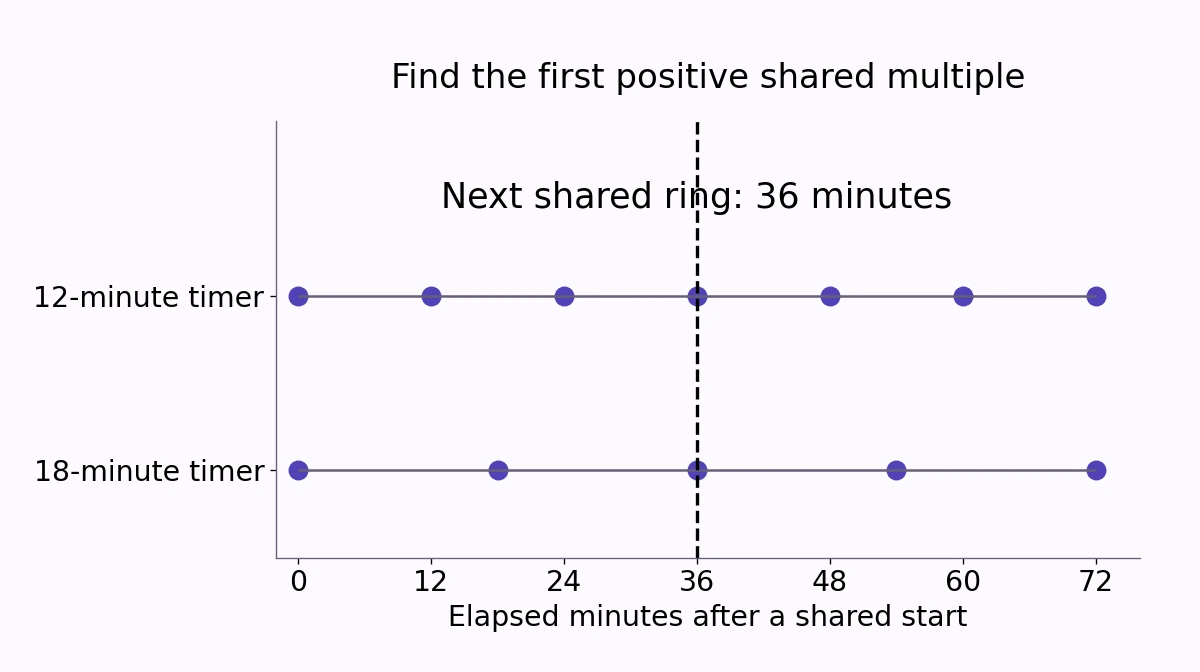
Find the first shared time after the start
The 12-minute timer rings at elapsed times 0, 12, 24, 36, 48, and so on. The 18-minute timer rings at 0, 18, 36, 54, and so on. The first shared positive value is 36.
Thirty minutes is \(12+18\), but neither schedule requires both timers to ring then. Adding two periods describes waiting through one period and then another, not finding a shared event.
Zero is shared because the timers start together. The question asks for the next meeting, so we need the least positive shared multiple.
Prime factors explain the result
Twelve is \(2^{2}\times3\), while eighteen is \(2\times3^{2}\). A number divisible by both must contain at least two factors of 2 and two factors of 3. Their product is \(2^{2}\times3^{2}=36\).
Taking only the shared factors gives \(2\times3=6\), the greatest common divisor. Six divides both intervals, but it is not itself a multiple of either. Divisors and multiples answer opposite kinds of questions.
For positive integers a and b, the relation \(\operatorname{LCM}(a,b)=\frac{ab}{\operatorname{GCD}(a,b)}\) gives the same result: \(\frac{12\times18}{6}=36\). Dividing before multiplying is also useful when implementing the calculation with limited-size integers.
The starting times are part of the problem
The 36-minute answer depends on the timers ringing together initially. If the 12-minute timer first rings six minutes after noon, its events are at 6, 18, 30, 42, and so on. It meets the other timer at 18 minutes instead.
Their common events then repeat every 36 minutes, but 36 is no longer the first meeting after noon. A repeat interval and a first event time are different pieces of a schedule.
Other offsets can prevent any exact meeting. A timer ringing at 5, 17, 29, and so on is always five minutes beyond a multiple of six. An 18-minute timer starting at zero is always at a multiple of six.
Use a shared unit
Convert periods into the same exact unit before applying an integer LCM. Half a minute and three quarters of a minute can be written as 30 and 45 seconds, giving a shared period of 90 seconds.
This reasoning assumes fixed exact intervals. Real timers can drift, so the arithmetic describes the stated model. For a refresher on whole-number operations, see MathBlog’s arithmetic reference.