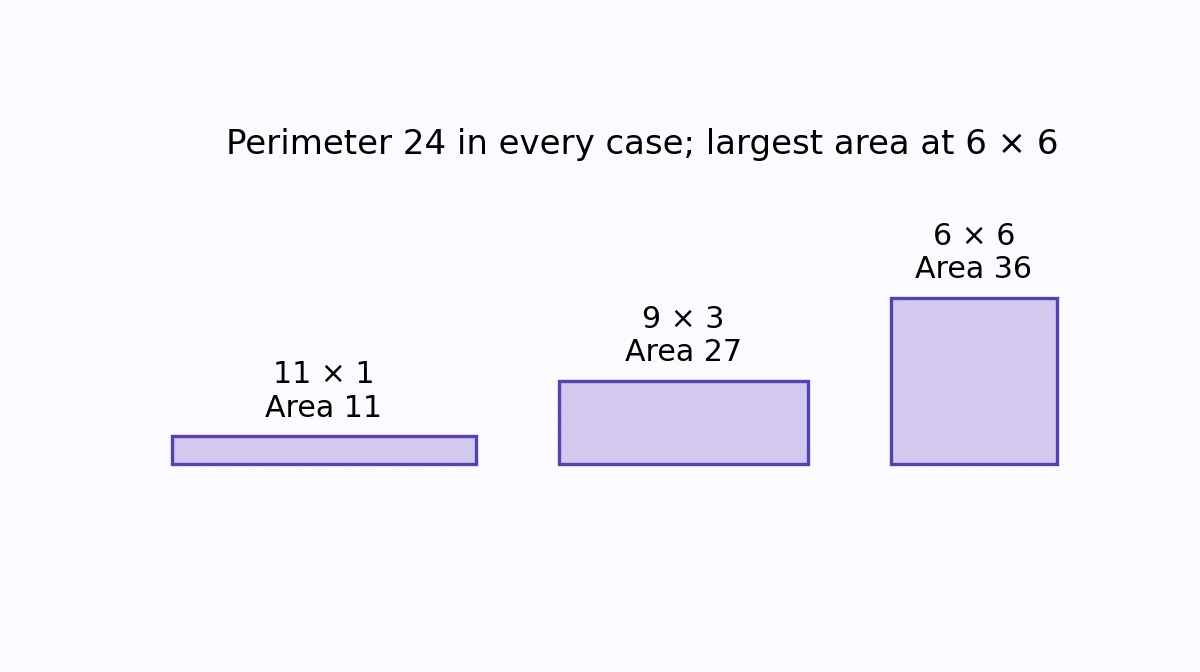
The pairs 1 and 11, 3 and 9, and 6 and 6 all add to 12. Their products are 11, 27, and 36. A fixed sum does not fix the product, and the most balanced pair gives the largest product here.
A simple rectangle makes the difference visible: keeping the sum of its side lengths fixed still leaves many possible shapes and areas.
Use one variable for both numbers
If the first number is x, the second must be \(12-x\). Their product is \(P=x(12-x)=12x-x^{2}\). With nonnegative numbers, x ranges from 0 to 12.
Rewrite the same expression as \(P=36-(x-6)^{2}\). A square is never negative, so subtracting it from 36 can never give a value above 36. Equality occurs when \(x-6=0\).
This proves the maximum at \(x=6\), rather than merely checking several pairs. It also shows why moving either direction away from the balanced pair lowers the product.
Measure the imbalance
Write the numbers as \(6-d\) and \(6+d\). Their product is \((6-d)(6+d)=36-d^{2}\). A difference of 2 between the numbers corresponds to \(d=1\) and product 35. A difference of 10 corresponds to \(d=5\) and product 11.
The loss from the maximum depends on the square of the half-difference. Doubling that imbalance multiplies the loss by four.
A rectangle turns the sum into a perimeter
A rectangle with side lengths x and \(12-x\) has perimeter \(2[x+(12-x)]=24\). Its area is their product, so the square 6 by 6 has the largest area among rectangles with this perimeter.
The unit matters: a perimeter of 24 inches leads to a maximum area of 36 square inches. Comparing the two numbers directly would mix linear and square units.
The claim is about rectangles with freely chosen positive side lengths. It does not automatically solve a construction problem with fixed panels, minimum widths, or other constraints.
The same idea works for another sum
For a fixed real sum S, write the numbers as \(\frac{S}{2}-d\) and \(\frac{S}{2}+d\). Their product is \(\frac{S^{2}}{4}-d^{2}\), so its largest possible value is \(\frac{S^{2}}{4}\) at equal numbers.
If the numbers must be integers and S is odd, exact equality is impossible. The nearest integers give the maximum. For a sum of 13, the pair 6 and 7 gives product 42.
For a nonnegative fixed sum, allowing a number to grow negative sends the product downward without bound; it does not create a larger maximum. This is a useful example of how the allowed inputs affect an optimization question. See MathBlog’s quadratic reference for related algebraic forms.