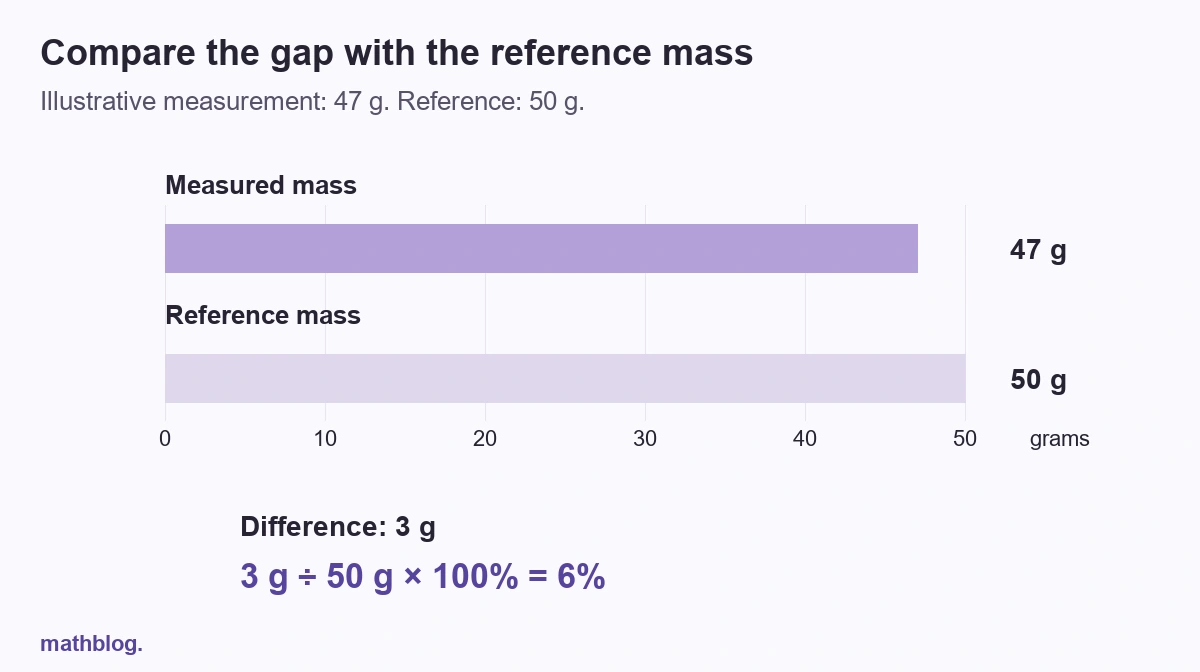
A student measures a sample at 47 grams. The reference mass is 50 grams. The measurement is 3 grams below the reference, giving a percent error of 6%.
Percent error compares the size of that difference with the reference value. Here, the absolute-value convention reports the size of the error without its direction.
Find the size of the difference
Subtract the reference value from the measurement, then take the absolute value. The signed difference is \(47-50=-3\) grams. Its magnitude, the absolute error, is 3 grams.
\[|47-50|=|-3|=3\text{ grams}\]
If the student had measured 53 grams, the difference would be 3 grams above the reference. The absolute error would still be 3 grams.
Divide by the reference value
Use 50 grams in the denominator, then multiply by 100% to express the ratio as a percentage.
\[\text{Percent error}=\frac{|47-50|}{50}\times100\%=\frac{3}{50}\times100\%=6\%\]
The grams cancel because both measurements use the same unit. Converting both values to kilograms gives the same result: \(\frac{0.003}{0.050}=0.06\). Dividing by the measured value, 47, would answer a different comparison and would give about 6.38%.
State the convention and check the reference
For measured value \(m\) and a positive reference value \(R\), the absolute-value form is
\[\text{Percent error}=\frac{|m-R|}{R}\times100\%\]
Some instructions use a signed version to retain the direction of the difference. With measured-minus-reference in the numerator, this example gives −6%; reversing the subtraction gives +6%. Follow the stated convention when a problem asks for a signed result.
A measurement equal to the reference has zero percent error. A zero reference makes this formula undefined because it would require division by zero. In that case, report the difference in the original units rather than assigning a percentage with this formula.