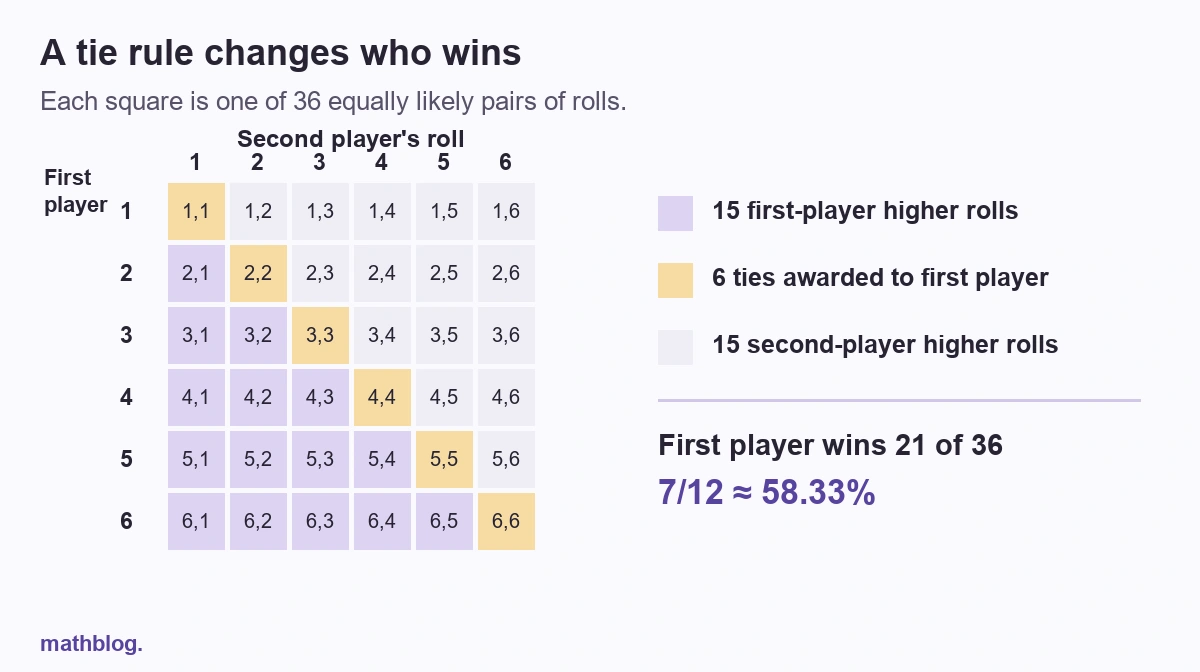
Two players each roll a fair six-sided die. The higher number wins, and the first player also wins a tie. Under those rules, the first player wins with probability \(\frac{7}{12}\), or about 58.33%.
Assume the rolls are independent. The advantage comes from giving all the tied results to one player.
Count the 36 possible pairs
Keep track of which number belongs to which player. A first-player 2 and second-player 5 is a different outcome from a first-player 5 and second-player 2. There are six choices for each roll, giving \(6\times6=36\) equally likely ordered pairs.
For a first-player roll of 1, there are no smaller second-player rolls. For a roll of 2, there is one. Continue through 6 and add \(0+1+2+3+4+5=15\) strict wins. The second player has the same count of strict wins.
| Comparison | Number of pairs |
|---|---|
| First player rolls higher | 15 |
| Numbers match | 6 |
| Second player rolls higher | 15 |
The six ties are one pair for each matching number, from two 1s through two 6s. The counts add to 36.
Give the ties to the first player
Use the equally likely outcome rule for probability: divide the winning count by the total count.
\[P(\text{first player wins})=\frac{15+6}{36}=\frac{21}{36}=\frac{7}{12}\]
The second player wins the remaining \(\frac{15}{36}=\frac{5}{12}\) of outcomes, about 41.67%. Compared with an equal 50% chance, the first player’s chance is higher by \(\frac{1}{12}\), or \(8\frac{1}{3}\) percentage points. The gap between the two players’ chances is twice that: \(16\frac{2}{3}\) percentage points.
What if both players reroll a tie?
If both players independently reroll whenever their numbers match, the game ends on one of the 30 unequal pairs. Fifteen favor each player, so each has a \(\frac{15}{30}=\frac12\) chance of eventually winning.
That rule keeps the strict wins balanced. A rule that awards every tie to the first player gives that player all six extra winning pairs. Specify the tie rule before comparing the players’ chances.