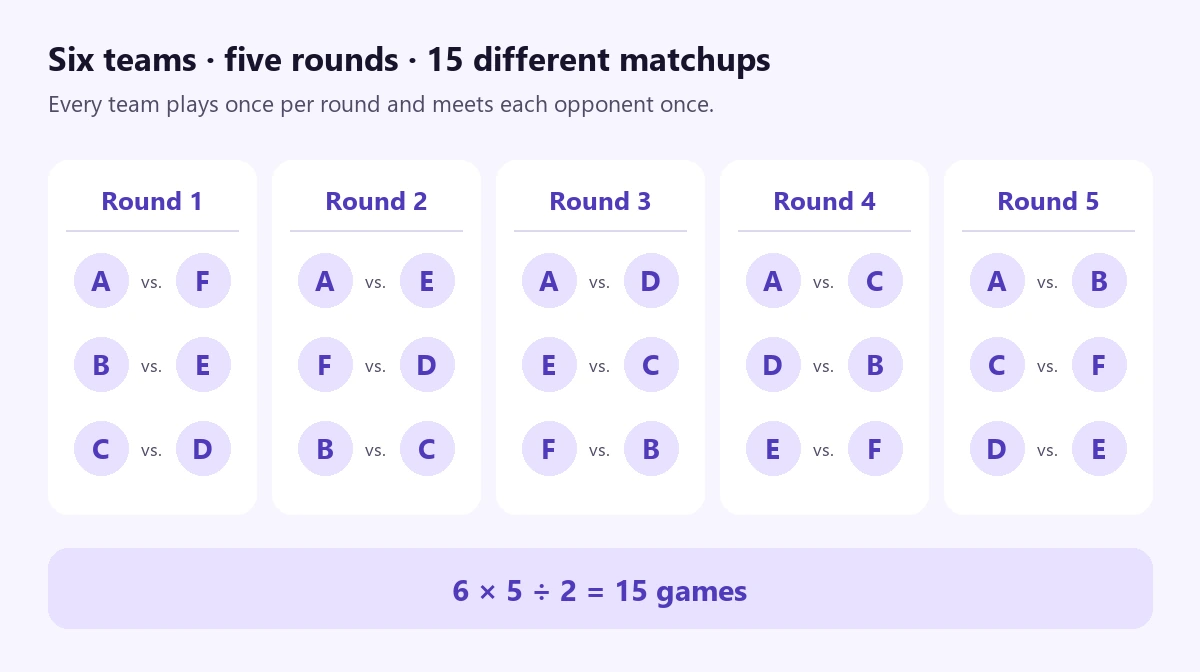
Six teams can each play every opponent once in five rounds. Put three games in each round, with every team appearing once. The full schedule contains 15 different matchups.
Label the teams A through F. A rotating pattern gives each team a new opponent in every round and lets you check the entire schedule before play begins.
Count the games and the minimum rounds
Each team has five opponents. Counting five games for each of six teams gives 30 team appearances, with two appearances belonging to each game. Divide by two to get the game count.
\[\frac{6\times5}{2}=15.\]
Equivalently, choose an unordered pair from six teams: \(\binom{6}{2}=15\). A versus B and B versus A describe the same matchup. You can check that count with the permutations and combinations calculator using six objects and a selection of two.
Every team needs five games. If a team can play at most once per round, the tournament needs at least five rounds. The schedule below reaches that minimum.
A five-round schedule
| Round | Game 1 | Game 2 | Game 3 |
|---|---|---|---|
| 1 | A vs. F | B vs. E | C vs. D |
| 2 | A vs. E | F vs. D | B vs. C |
| 3 | A vs. D | E vs. C | F vs. B |
| 4 | A vs. C | D vs. B | E vs. F |
| 5 | A vs. B | C vs. F | D vs. E |
Follow Team A down the table. Its opponents are F, E, D, C, and B. Check another team the same way, then check that all 15 unordered pairs appear exactly once. Each row also contains all six labels, so every team has one game in that round.
Build the schedule by rotating five labels
This version of the circle method starts with the list \((A,B,C,D,E,F)\). Pair the first label with the last, the second with the fifth, and the third with the fourth. That gives A–F, B–E, and C–D.
Keep A fixed. Move the last label into the second position and shift the other four labels one place to the right. The list becomes \((A,F,B,C,D,E)\). Pair from the ends again to get A–E, F–D, and B–C for Round 2. Repeat the same move for the remaining rounds.
Turn rounds into playing times
With three courts or fields available, the three games in a round can run together. With one playing area, the tournament still needs 15 game slots. Allow time for each game and any breaks when assigning the actual start times.
The pair labels identify opponents. Assign home and away separately if the sport needs them. A second meeting between every pair would add another 15 games.