Count ordered and unordered selections from distinct objects without replacement. Enter the number of available objects n and the number selected r. The tool returns both permutations \(P(n, r)\) and combinations \(C(n, r)\) as exact integers.
Choose the interpretation before using the answer. A sequence of distinct roles usually requires permutations; a group defined only by membership usually requires combinations.
Count permutations and combinations
Use whole numbers: 0–1000 distinct objects, and a selection size from 0 up to that number. This tool assumes no replacement. Order matters for permutations; order does not matter for combinations.
Calculations run in your browser. Your entries are not sent to a MathBlog calculation service. Exact results and approximate values are labeled separately.
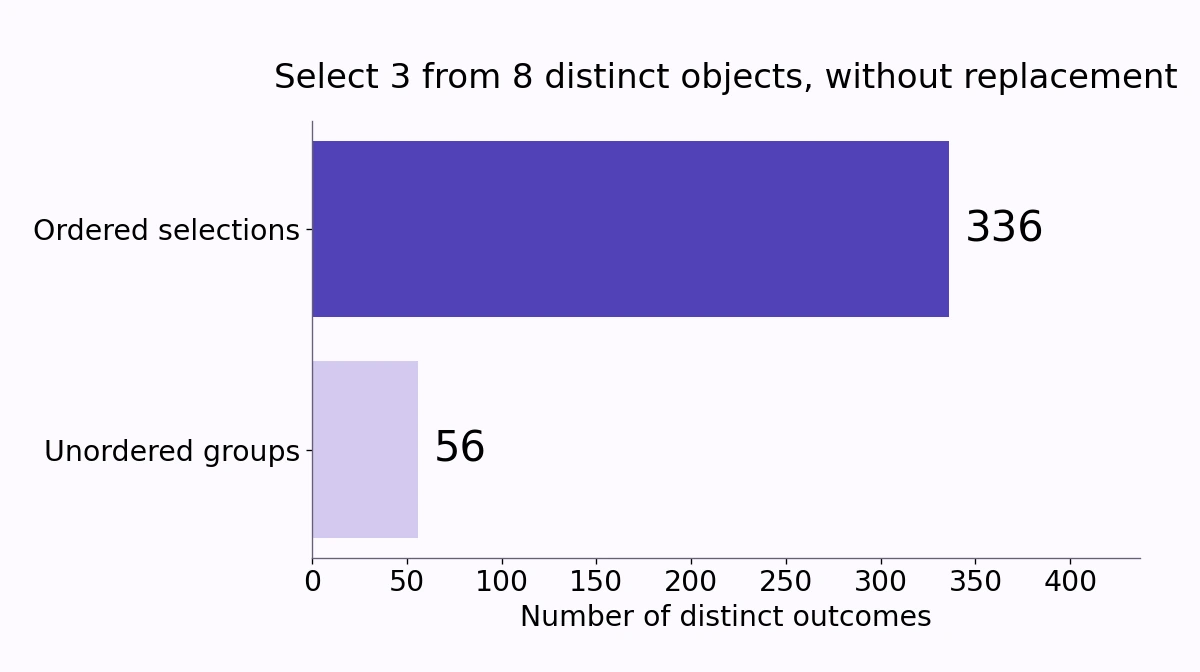
Example: choose 3 from 8
For an ordered selection, there are 8 choices for the first position, 7 for the second, and 6 for the third. Thus \(P(8,3) = 8 \times 7 \times 6 = 336\).
Each unordered three-object group has \(3! = 6\) internal arrangements. Dividing 336 by 6 gives \(C(8,3) = 56\). A podium and an unranked team can therefore have different counts even when they use the same n and r.
The formulas
\(P(n,r)=\frac{n!}{(n-r)!}\) counts ordered choices. \(C(n,r)=\frac{n!}{r!(n-r)!}\) counts unordered choices. Here n and r are whole numbers with \(0 \le r \le n\).
The tool calculates products directly rather than forming approximate floating-point factorials and dividing them. Large results remain exact integers. They may contain many digits; the result wraps within its display panel.
Special cases
Selecting zero objects gives one empty selection, so \(P(n,0)=C(n,0)=1\). This also includes \(n = 0\) and \(r = 0\). Selecting every object gives \(n!\) ordered arrangements but only one unordered group.
If r is larger than n, the input is rejected because this tool does not allow replacement. Negative and fractional entries are also rejected. Both fields must be whole numbers, with n at most 1000.
When another model is needed
These formulas assume the objects are distinct and cannot be used twice in one selection. They do not handle repeated symbols in a string, indistinguishable objects, or arrangements identified up to rotation around a circle.
When each of r ordered positions may independently use any of n symbols with replacement, the count is \(n^r\), a different formula. An unordered selection with repetition needs a different model again.
A count also does not establish the probabilities of the outcomes. Equal probability must be justified separately. See MathBlog’s probability reference for connecting event counts with probabilities under an explicitly stated sample-space model.