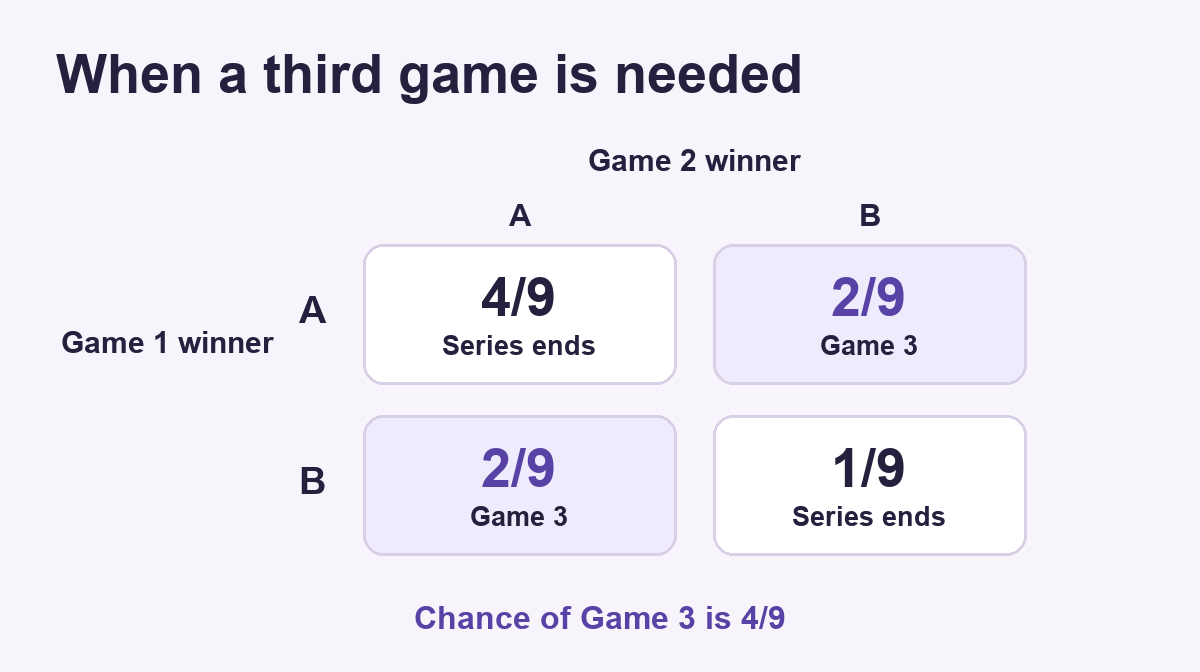
A best-of-three series reaches Game 3 whenever the teams split the first two games. If one team has a \(\frac{2}{3}\) chance of winning each game and the game results are independent, the chance of a third game is \(\frac{4}{9}\), or about 44.4%.
Call the favored team A and its opponent B. Every game has a winner, so B has a \(\frac{1}{3}\) chance of winning each game. The first team to win twice takes the series.
Count both orders of a split
A can win Game 1 and B can win Game 2, or B can win Game 1 and A can win Game 2. Independence means the Game 2 win probabilities stay the same whichever team wins Game 1. Multiply along each order.
\[P(\text{A then B})=\frac{2}{3}\times\frac{1}{3}=\frac{2}{9}\]
\[P(\text{B then A})=\frac{1}{3}\times\frac{2}{3}=\frac{2}{9}\]
Only one order can happen in a series, so add the two probabilities. That gives \(\frac{2}{9}+\frac{2}{9}=\frac{4}{9}\).
Check by counting the sweeps
The series ends in two games if A wins both or B wins both. An A sweep has probability \(\frac{4}{9}\), and a B sweep has probability \(\frac{1}{9}\). Together, sweeps account for \(\frac{5}{9}\) of the probability, leaving \(\frac{4}{9}\) for a third game. The matching-birthdays problem uses the same idea of counting the opposite outcome first.
Update the chance after Game 1
The \(\frac{4}{9}\) applies before either game is played. If A wins Game 1, the series needs B to win Game 2, which has probability \(\frac{1}{3}\). If B wins Game 1, it needs A to win Game 2, which has probability \(\frac{2}{3}\).
Before the opener, the same calculation works for any fixed per-game win probability \(p\) for A. The chance of a third game is \(2p(1-p)\). With evenly matched teams, \(p=\frac{1}{2}\) and the chance is 50%. If conditions such as home advantage change the win probabilities from one game to the next, use the appropriate probability for each game. If the first result affects the odds for Game 2, use the Game 2 probabilities conditional on the Game 1 winner.