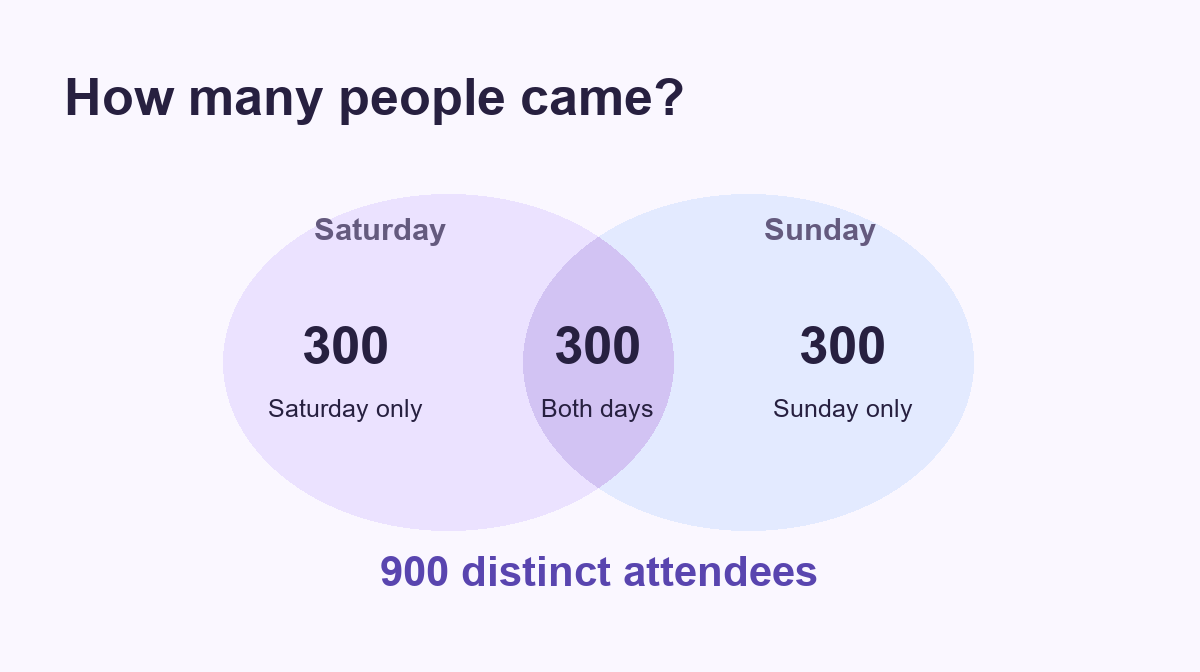
A two-day event draws 600 people on Saturday and 600 on Sunday. The two daily totals add to 1,200, but the event drew 900 distinct people. Three hundred attendees came on both days.
The same people appear on both lists. To find how many different people came over the weekend, subtract the overlap once.
Count the overlap once
Let \(A\) be the set of Saturday attendees and \(B\) the set of Sunday attendees. Everyone who came on either day belongs to their union, \(A\cup B\). People who came on both days belong to the intersection, \(A\cap B\).
Adding the daily counts includes each person in the intersection twice. The two-set inclusion-exclusion rule removes one copy of each duplicate.
\[|A\cup B|=|A|+|B|-|A\cap B|=600+600-300=900.\]
Check the result with three disjoint groups. Three hundred people came only on Saturday, 300 came on both days, and 300 came only on Sunday. The distinct count is \(300+300+300=900\).
What if you only have the two counts?
The weekend headcount could be anywhere from 600 to 1,200. At the low end, everyone who came on Saturday came back on Sunday. At the high end, the lists share no one. The daily totals alone leave the overlap unknown.
Check what the attendance report measures
The total of 1,200 attendee-days describes how much attendance the event handled across both days. Use it to plan staffing for a similar weekend. Use the 900 distinct attendees to describe how many people the event reached.
To calculate the distinct count from registration data, count each person once across both days. Check that a returning attendee has the same identifier in both lists and that separate attendees do not share one identifier.