Two fair six-sided dice show a 2 and a 5. You win if your final roll shows two fives or two sixes. You have one chance to reroll, and you can choose to reroll either die or both.
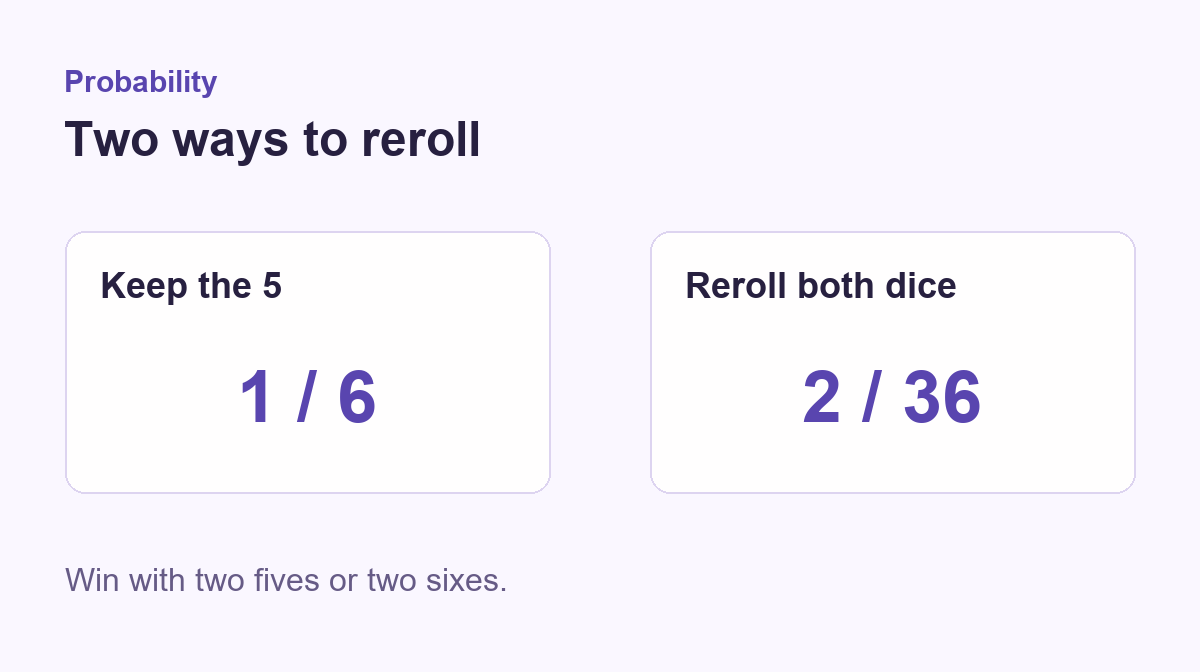
Keep the 5 and reroll the 2. One face out of six completes a winning pair. Starting over with both dice gives you two ways to win across 36 equally likely outcomes.
Keep the 5 and count the faces on one die
With the 5 already on the table, the six possible values on the rerolled die give six equally likely results. Only a 5 makes a winning pair. A 6 would leave you with a 6 and a 5, so this choice gives a winning probability of \(1/6\).
If you keep the 2, neither winning pair is possible. Keeping both dice also leaves you short of a winning pair.
Reroll both and count ordered pairs
Give the dice different colors in your head so you can tell which one landed on which number. Each of the six faces on the first die can go with six faces on the second. The two winning results are \((5,5)\) and \((6,6)\), and there are 36 ordered pairs in all.
\[\frac{2}{6\times 6}=\frac{2}{36}=\frac{1}{18}.\]
| Choice | Chance of winning |
|---|---|
| Keep the 5 | \(1/6\) |
| Keep the 2 | \(0\) |
| Reroll both | \(1/18\) |
What if the first roll were a 3 and a 4?
Keeping either die leaves a 3 or a 4 in the final pair. Reroll both for a chance to win. If a 6 were already showing alongside a number below 5, keeping the 6 would give the same \(1/6\) chance as keeping the 5 in the original example.
All of these chances apply after you have seen the first roll. To calculate the chance of winning from the beginning of the game, you would also account for how often you start with an instant win, one useful die, or neither.