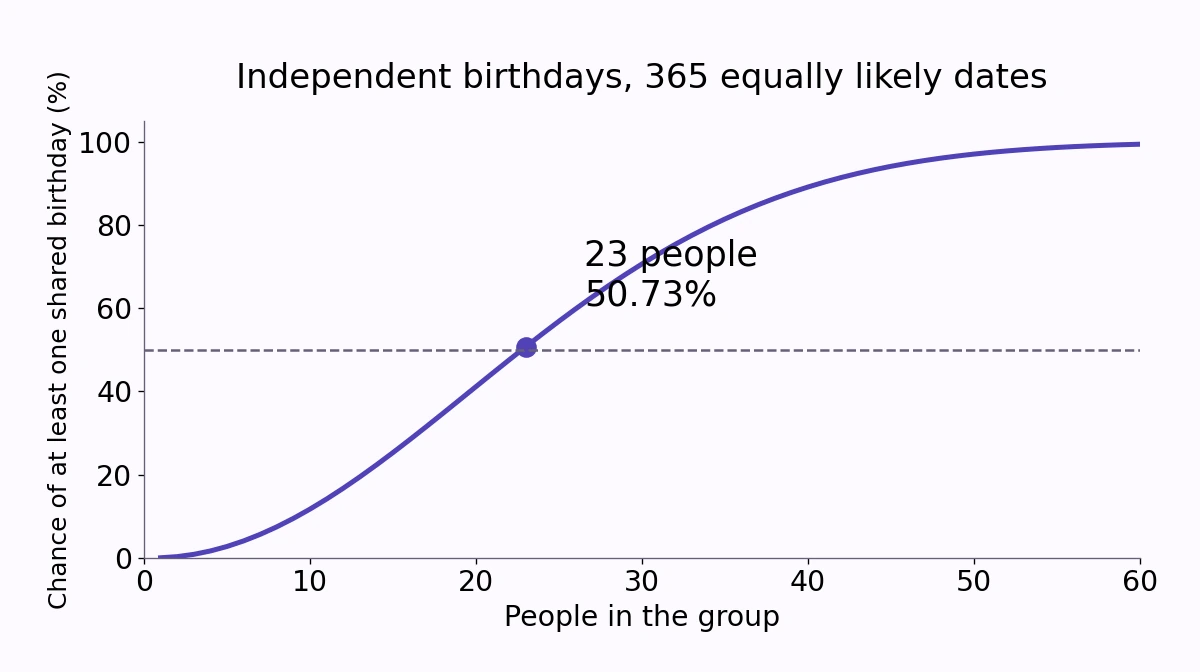
In a group of 23 people, the probability that at least two share a birthday is about 50.73% under the usual simplified model. That is much larger than many people expect because the question compares every pair, rather than comparing everyone with one chosen person.
The model assumes independent birthdays, 365 equally likely dates, and no leap-day birthdays. Actual birthday patterns are not perfectly uniform, so this is a mathematical model, not an exact forecast for every real group.
Count the ways a match can occur
Twenty-three people create \(\frac{23\times22}{2}=253\) distinct pairs. A birthday match in any one of those pairs satisfies the question. The number of pairs grows much faster than the number of people.
Multiplying 253 by \(\frac{1}{365}\) is not the exact answer. The match events overlap: several pairs can match in the same group. Adding their probabilities would count some outcomes more than once.
Calculate the opposite event
It is easier to find the probability that every birthday is different. The first person can have any date. The second must avoid that date, giving \(\frac{364}{365}\). The third must avoid two dates, giving \(\frac{363}{365}\), provided the first two were distinct.
Continue that conditional reasoning through the group. For n people up to 365, the probability of no match is \(1\times\frac{364}{365}\times\frac{363}{365}\times\cdots\times\frac{365-n+1}{365}\).
Subtract the product from one to obtain the probability of at least one match. With \(n=23\), the result is approximately 0.507297, or 50.73%. With 22 people it is about 47.57%, so 23 is the first group size that exceeds one half in this model.
Matching one specified person is different
Suppose the question is whether someone among 22 other people shares your birthday. Each must avoid one particular date for there to be no match, giving \(\left(\frac{364}{365}\right)^{22}\).
The probability of at least one match with your birthday is therefore \(1-\left(\frac{364}{365}\right)^{22}\), about 5.86%. That is far smaller because matches between two other people no longer count.
State which event you mean
“At least two share a birthday” includes three people sharing one date and multiple matching pairs. It does not mean exactly one pair. Counting only one specific arrangement would omit other successful outcomes.
With 366 people and only 365 allowed dates, a shared birthday is certain by the pigeonhole principle. That certainty comes from the model’s date count, not from extending an approximate formula beyond its range.
The useful habit is to define the event, check its complement, and account for overlapping possibilities. MathBlog’s probability guide develops the basic rules behind that approach.