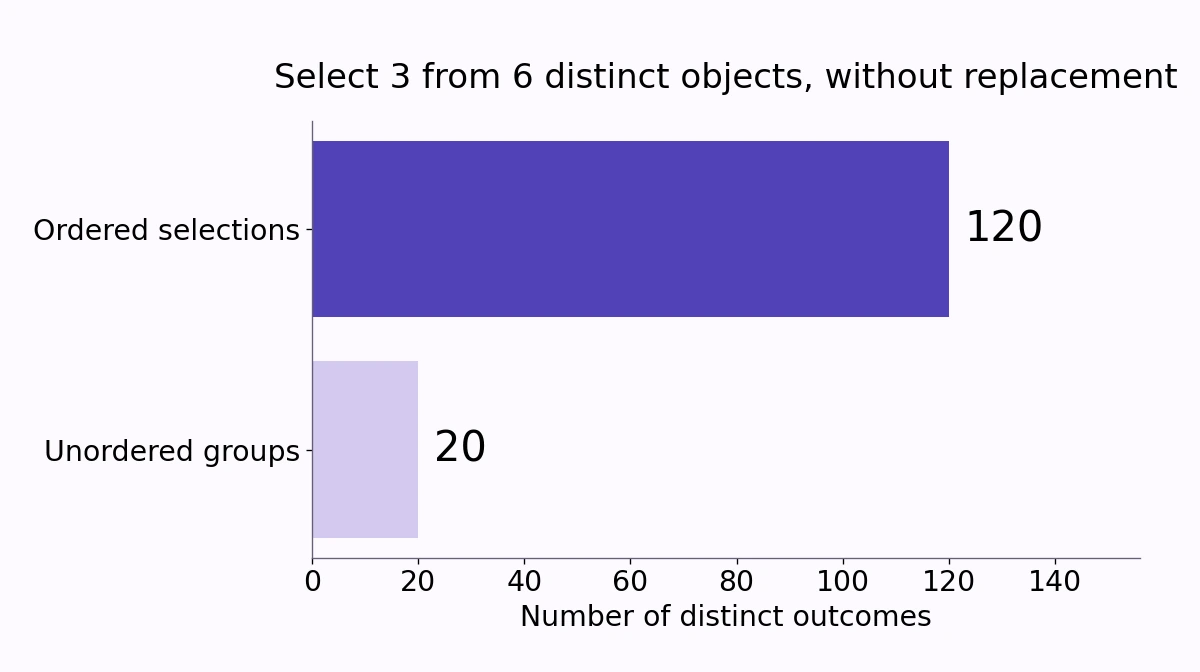
Six people are available for a three-person team. There are 20 possible teams. If the same six people compete for three distinct podium places, there are 120 possible podiums. The difference is whether order creates a new outcome.
Before reaching for a factorial, describe what would make two selections count as different. That sentence determines which counting model fits.
A team does not come with an order
The team containing Ava, Ben, and Cam is the same team whether its members are listed as Ava–Ben–Cam or Cam–Ava–Ben. Rearranging the names does not change membership.
Start by counting ordered selections: there are 6 choices for a first person, 5 remaining choices for a second, and 4 for a third. That gives \(6\times5\times4=120\) ordered lists.
Each three-person team appears \(3\times2\times1=6\) times among those lists. Dividing 120 by 6 leaves 20 distinct teams. This is the combination \(C(6,3)\).
A podium has three different roles
Ava first, Ben second, and Cam third is a different result from Cam first, Ben second, and Ava third. The ordered lists now represent genuinely distinct outcomes.
There is no reason to divide by the six internal arrangements. The answer remains 120, the permutation \(P(6,3)\).
A committee with a president, secretary, and treasurer behaves like the podium if each role must be held by a different person. Calling it a committee does not make order irrelevant; the roles distinguish outcomes.
Check replacement and distinctness
Both calculations assume six distinct people and no repeated person within a selection. A person cannot occupy two podium places. Selecting a three-character code where characters may repeat requires another model.
For three positions chosen independently from six symbols, allowing repetition gives \(6^{3}=216\) strings. That does not count three-person teams or podiums without replacement.
Identical objects create another difference. Rearranging two indistinguishable red counters does not necessarily produce a new physical arrangement, even if a labeled-object formula would count it twice.
Counting outcomes is not yet a probability
Knowing there are 20 possible teams does not establish that every team is equally likely under a real selection process. Preferences, eligibility rules, or a biased draw can change the probabilities.
For a uniform random choice among those 20 teams, a specified team has probability \(\frac{1}{20}\). The equal-likelihood assumption belongs in the explanation, not hidden inside the counting formula.
Ask three questions: does order matter, may an object be selected again, and are the objects distinct? Then use the corresponding count. MathBlog’s probability reference explains the additional step from counting to a probability.