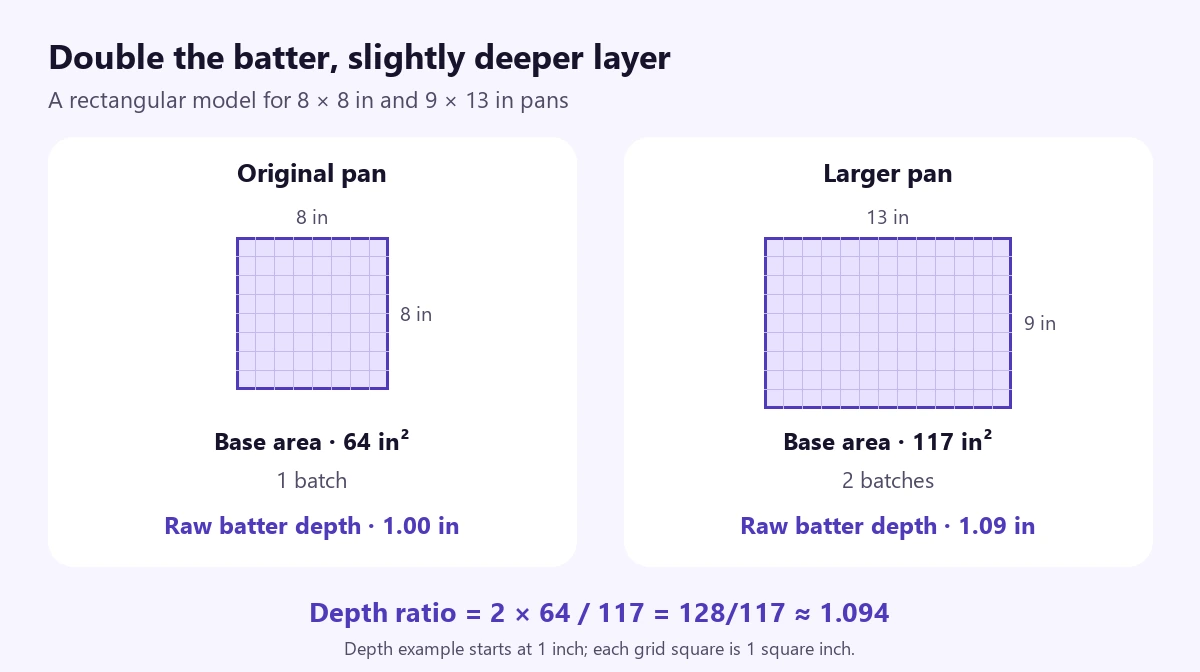
Double the batter from a recipe for an 8-by-8-inch pan and pour it into a 9-by-13-inch pan. Under a rectangular model, the raw batter will be about 9.4% deeper than it was in the smaller pan.
The new pan has nearly twice the base area. Comparing that area with the doubled volume tells you how much the depth changes.
Divide batter volume by the base area
Treat each pan as a box with a flat rectangular base and vertical sides. Assume the batter settles into an even layer and doubling the batch gives twice the raw batter volume.
The area of a rectangle is length times width. The two base areas are
\[A_1=8\times8=64\text{ in}^2,\qquad A_2=9\times13=117\text{ in}^2.\]
Volume equals base area times depth, so depth equals volume divided by base area. If the original volume is \(V\) cubic inches, the two depths, in inches, are \(h_1=V/64\) and \(h_2=2V/117\). Divide the second by the first to compare them.
\[\frac{h_2}{h_1}=\frac{2V/117}{V/64}=\frac{128}{117}\approx1.094.\]
The volume cancels. That makes the relative change the same for any starting depth within this model. The increase is \(\frac{11}{117}\times100\%\approx9.4\%\). If the original batter was 1 inch deep, the doubled batch would be about 1.09 inches deep.
Match the batter increase to the area increase
To keep the original depth, multiply the batter volume by the ratio of the new area to the old area.
\[\frac{117}{64}=1.828125.\]
That calls for about 1.83 times the original batter volume, an increase of about 82.8%. Two full batches give a little more batter, which accounts for the deeper layer.
You can check the numbers with a hypothetical 1-inch starting layer. It holds 64 cubic inches of batter. The new pan holds 117 cubic inches at the same depth, while a doubled batch supplies 128 cubic inches. The extra 11 cubic inches spread over 117 square inches add about 0.094 inch.
Use the model with the actual pan
Measure the interior base of each pan. Rounded corners and sloping sides can change how its capacity grows with depth. King Arthur Baking recommends comparing bottom surface areas when choosing substitute pans and notes that different batter depths can change baking time.
The calculation gives a raw batter depth estimate. Follow the recipe’s pan guidance and doneness checks, allowing space for the batter to rise.