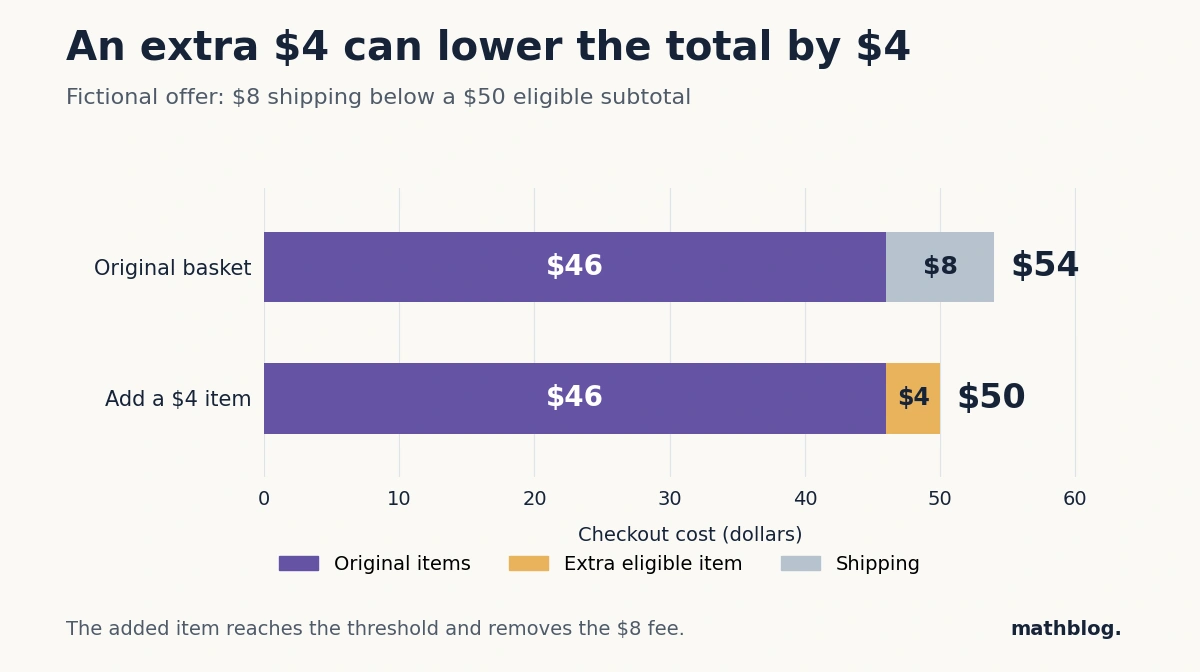
A fictional store charges $8 to ship a $46 basket and offers free shipping when eligible merchandise reaches $50. The original bill is $54. Add an eligible $4 item, and the bill falls to $50.
The added item raises the merchandise subtotal but removes a larger charge. Whether that works depends on the item’s price and the exact shipping rule. In this example, the threshold uses the merchandise subtotal before tax, all items qualify, and there are no other charges.
Write both checkout totals
Keep the original $46 of merchandise in both comparisons. Without an extra item, you pay \(46+8=54\) dollars. With the $4 item, the merchandise total becomes \(46+4=50\), which qualifies for free shipping.
| Charge | Original basket | Add the $4 item |
|---|---|---|
| Original merchandise | $46 | $46 |
| Extra merchandise | $0 | $4 |
| Shipping | $8 | $0 |
| Total | $54 | $50 |
The difference is \(8-4=4\) dollars. That is the reduction in the checkout bill; it does not assign a value to the extra item.
Find the prices that lower the bill
Let \(x\) be the price of the added eligible item, in dollars. To remove shipping, it must close the $4 gap between the basket and the threshold. That requires \(x\ge4\).
Once the basket qualifies, the total is \(46+x\). For that to beat the original $54 bill, you need \(46+x<54\), or \(x<8\). Both conditions must hold:
\[4\le x<8.\]
A $3 item fails the first condition. You still pay shipping, so the total rises to $57. A $7.99 item qualifies and brings the total to $53.99, saving one cent. An $8 item produces a $54 tie. A $9 item qualifies but raises the bill to $55.
The threshold changes the cost rule
For this starting basket, the checkout total follows two formulas:
\[C(x)=\begin{cases}54+x,&0\le x<4,\\46+x,&x\ge4.\end{cases}\]
The first formula includes the $8 shipping fee; the second does not. At $3.99, the total is $57.99. At $4, it drops to $50. The one-cent increase in merchandise crosses the threshold and removes the whole fee.
This is a piecewise function: the applicable formula depends on the input’s interval. When comparing two pricing plans, you can often follow each cost line over the whole range. Here you must also check where the store switches rules.
Separate the shortfall from the fee
Keep the $50 threshold separate from the $8 shipping charge. If a basket is below its threshold, an added item lowers the bill only when its price is at least the shortfall and less than the shipping fee it removes.
Suppose the same $46 basket instead faced a $60 threshold and an $8 fee. Reaching free shipping would require at least $14 of eligible extras. Even an exact $14 addition would produce a $60 bill, above the original $54. Available item prices matter, too: a useful price interval does not guarantee the store sells something in it.
Use the terms shown at checkout
A coupon might change the qualifying subtotal. An excluded item might cost money without moving the basket toward the threshold. Taxes, handling charges, or a different delivery option can change the comparison. For a real order, recalculate both final totals under the displayed terms, including any charges left out of this fictional example.