Two print shops charge the same $32 for eight prints. One shop charges $12 to set up the job and $2.50 for each print. The other charges $4 per print with no setup fee. For orders of other sizes, the cheaper shop depends on how many prints you need.
To compare the quotes, write a linear equation for each total. Set the totals equal to find the order size where the prices match. Then use that number to decide which shop costs less for your order.
Write one equation for each plan
Let \(x\) be the number of prints and \(y\) be the total cost in dollars. Use the same \(x\) for both shops so the equations compare orders of the same size. These fictional quotes assume whole prints and no other charges.
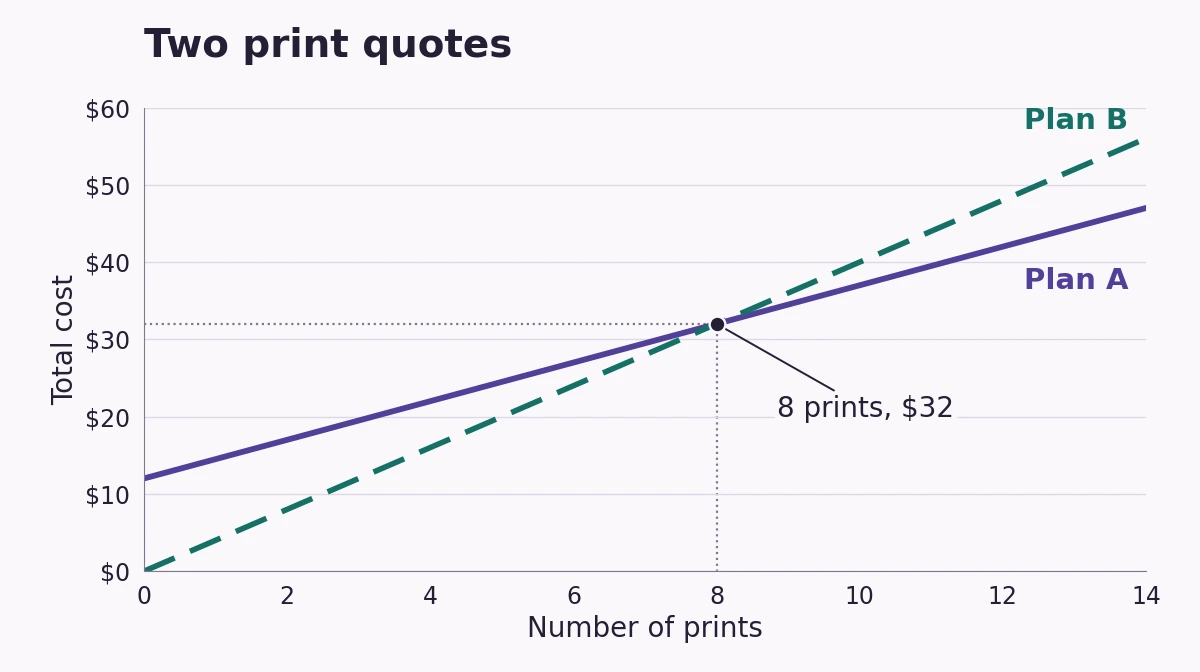
- Plan A uses \(y=12+2.50x\). The $12 fee appears once, and $2.50 is added for each print.
- Plan B uses \(y=4x\). Each print adds $4 to the total.
The setup fee is the starting value. The price per print is the slope of each line because it tells you how much the total rises when \(x\) goes up by one. Plan A starts $12 higher. Every extra print narrows that initial gap by $1.50 until the totals meet.
Set the two costs equal
At the point where the quotes match, both expressions give the same value of \(y\). Solve the equation by subtracting \(2.50x\) from both sides and then dividing by \(1.50\).
\[\begin{aligned} 12+2.50x &= 4x\\ 12 &= 1.50x\\ x &= 8 \end{aligned}\]
Put eight into both cost equations to check the result. Plan A charges \(12+2.50(8)=32\) dollars, and Plan B charges \(4(8)=32\) dollars. The crossing point \((8,32)\) shows the number of prints on the horizontal axis and the shared cost in dollars on the vertical axis.
Decide which plan is cheaper
Subtract Plan B’s cost from Plan A’s cost. The difference is \(12-1.50x\). For fewer than eight prints it is positive, so Plan B is cheaper. For more than eight it is negative, so Plan A is cheaper. If you order whole prints, the first order size that makes Plan A cheaper is nine.
| Prints | Plan A | Plan B | Cheaper plan |
|---|---|---|---|
| 7 | $29.50 | $28.00 | Plan B |
| 8 | $32.00 | $32.00 | Same cost |
| 9 | $34.50 | $36.00 | Plan A |
Try a problem where the lines cross between whole numbers
Suppose a club can order badges for $10 plus $2 per badge or pay $5 per badge with no setup fee. Which quote is cheaper for three badges? What about four?
Set \(10+2x=5x\) to find that the lines cross at \(x=\frac{10}{3}\). Check the two whole-number quantities on either side. Three badges cost $16 or $15, so choose the quote with no setup fee. Four badges cost $18 or $20, so choose the quote with the setup fee. The two quotes never tie at a whole number of badges.