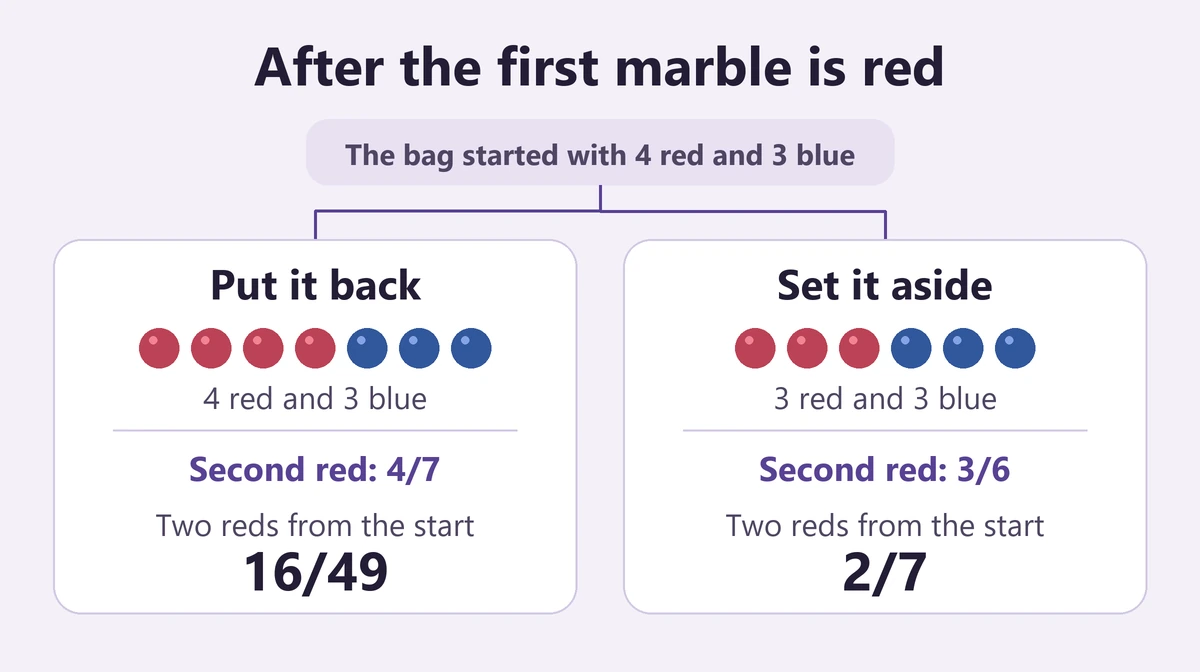
A bag holds four red marbles and three blue ones. You draw a red marble. Before reaching in again, you can put it back or set it aside. Putting it back leaves four red marbles out of seven. Setting it aside leaves three out of six.
Before either draw, the chance of getting red twice is \(\frac{16}{49}\) if you return the first marble and \(\frac{2}{7}\) if you set it aside. In both versions, assume you draw without looking and mix the bag so that every marble inside is equally likely to be picked.
Use the chance of red after the first draw
Let \(R_1\) mean the first marble is red and \(R_2\) mean the second marble is red. The multiplication rule gives the probability that both happen.
\[P(R_1\cap R_2)=P(R_1)\,P(R_2\mid R_1)\]
The vertical bar means “given.” Read the second factor as the chance of drawing red on the second draw, given that the first draw was red. The first factor is \(\frac{4}{7}\) in both versions. The second factor depends on what you do with the first marble.
With replacement, the bag goes back to seven
Return the red marble and mix again. With four red marbles among the seven, the chance of a second red is still \(\frac{4}{7}\). Under this drawing procedure, the first color leaves the second draw’s probabilities unchanged. For another example of independent trials, see the coin tosses in MathBlog’s probability reference.
\[P(R_1\cap R_2)=\frac{4}{7}\times\frac{4}{7}=\frac{16}{49}\]
Without replacement, there is one fewer red
Keep the first red marble out of the bag. Three red and three blue marbles remain, so \(P(R_2\mid R_1)=\frac{3}{6}=\frac{1}{2}\).
\[P(R_1\cap R_2)=\frac{4}{7}\times\frac{3}{6}=\frac{2}{7}\]
Had the first draw been blue, there would still be four reds among the six remaining marbles. The chance of red on the second draw would then be \(\frac{4}{6}\). If you’ve already seen the first color and only want to predict the next draw, use the fraction for the bag you have in front of you.
Why mixing matters
Drop the first marble back at the opening and grab the closest one again. That procedure can favor the marble you just returned, even though the bag holds the original seven. To model the draws above, mix after deciding whether to return the marble and draw again without looking. Each marble in the bag needs the same chance of being picked on that draw.