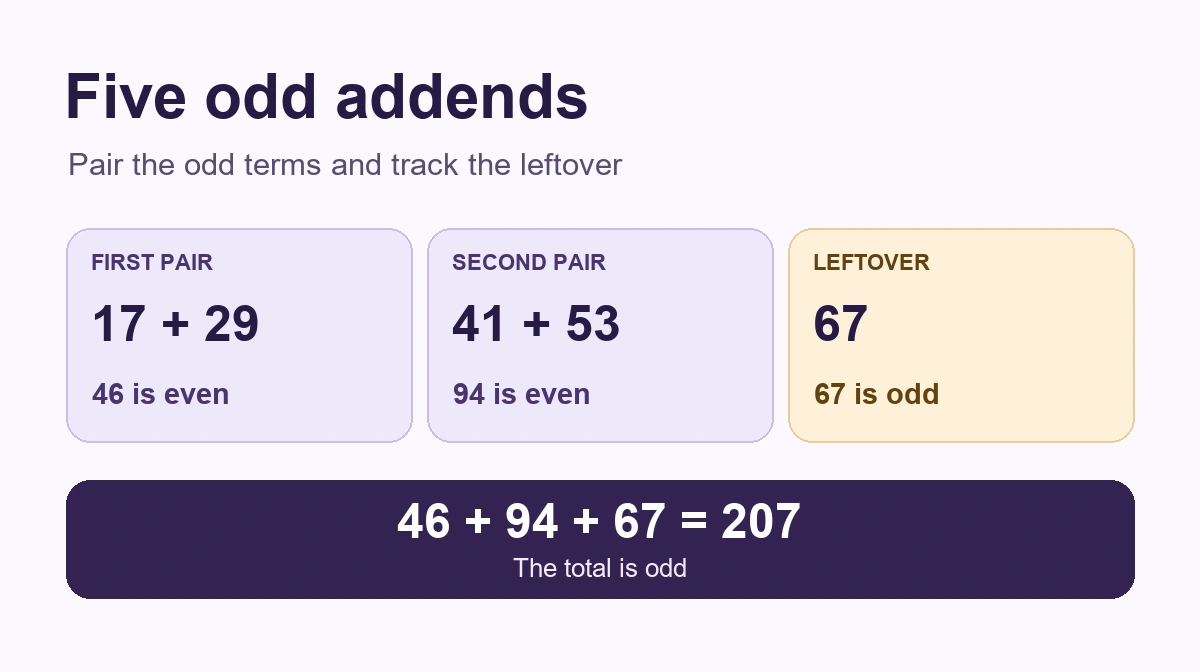
Can you tell whether \(17+29+41+53+67\) is odd before adding? Yes. There are five odd terms, and an odd number of odd integers always gives an odd sum. You can see why by putting the terms into pairs.
The first pair gives \(17+29=46\), and the second gives \(41+53=94\). Both subtotals are even. The leftover \(67\) makes the total, \(207\), odd. The same argument works when the numbers are negative or the list includes even terms.
Why two odd terms make an even subtotal
An odd integer is one more than a multiple of two. For example, \(17=16+1\) and \(29=28+1\). Add them and the two extra ones make another multiple of two. The even parts and that extra two add up to an even number.
Write any two odd integers as \(2a+1\) and \(2b+1\), where \(a\) and \(b\) are integers. Then
\[(2a+1)+(2b+1)=2(a+b+1).\]
The factor of two shows why any pair works. If the list contains an even number of odd integers, you can pair them all. If it contains an odd number, one odd integer remains after every possible pair. Adding that last odd integer to the even subtotals makes the total odd.
Count the odd terms in a mixed sum
Adding an even integer leaves the total even if it was even and odd if it was odd. That status is called its parity. Zero is even because \(0=2\cdot0\). Negative odd integers work just like positive ones. For example, \(-7=2(-4)+1\), so it still has the extra one in the pairing argument.
Try the mixed sum below. The odd terms are \(-7\), \(13\), and \(-5\), so you can predict an odd total. Pairing \(-7\) with \(13\) gives \(6\). Add the even terms \(8\) and \(0\), then the leftover \(-5\), to get \(9\).
\[8+(-7)+13+(-5)+0=9.\]
The algebra is short. Suppose there are \(m\) odd terms. Each contributes an even part and one extra unit, while each even term contributes only an even part. All the even parts add to some \(2A\), where \(A\) is an integer. The whole sum is \(2A+m\). That is why the parity of the sum matches the parity of the number of odd terms.
Use parity to spot an addition error
Suppose you add \(11\), \(24\), \(38\), and \(67\) and get \(141\). Only two terms are odd, so the result must be even. You already know to check the addition again. The correct total is \(140\).
An incorrect answer of \(142\) would pass the parity check too. Count the odd terms for a quick check, then add the numbers to confirm the exact total.