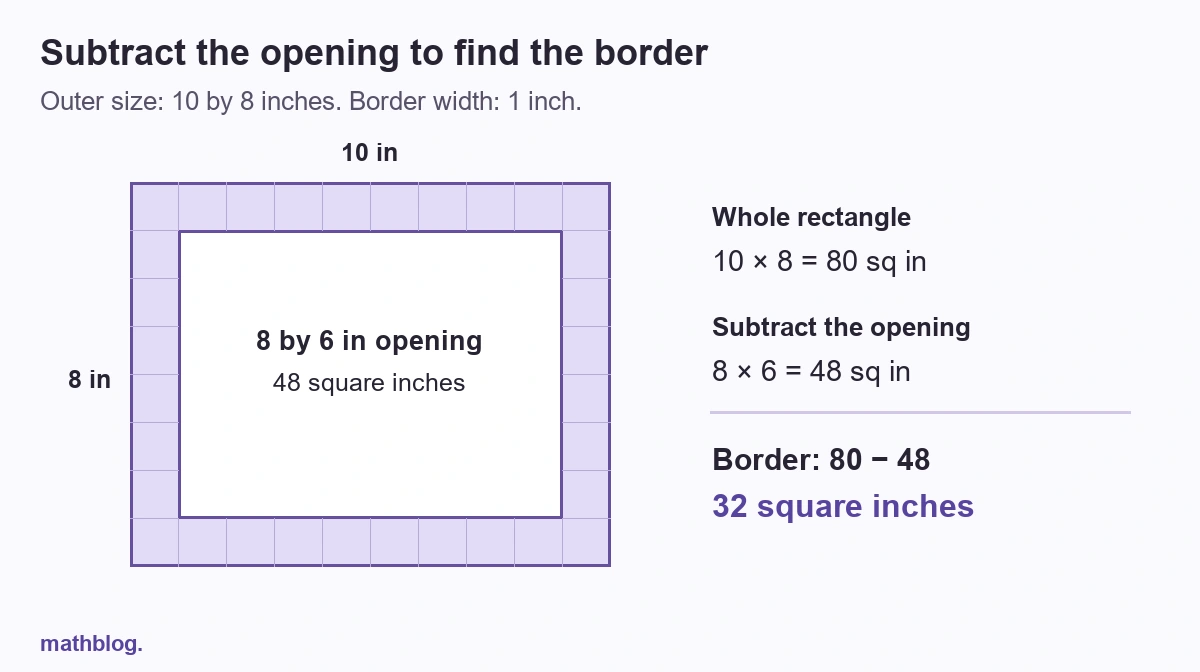
A rectangular mat measures 8 inches by 10 inches along its outside edges. Its border is 1 inch wide all the way around. The border covers 32 square inches.
Subtract the rectangular opening from the whole mat to find that area. Each dimension of the opening loses 1 inch at both ends.
Subtract two border widths from each dimension
Across the 8-inch side, the border uses 1 inch on the left and 1 inch on the right. That leaves \(8-2=6\) inches. Along the 10-inch side, the opening measures \(10-2=8\) inches.
Use the area formula for a rectangle on the outside and the opening.
\[A_{\mathrm{border}}=(8\times10)-(6\times8)=80-48=32\text{ square inches}\]
Subtracting the border width only once from each dimension would make the opening too large. The border occupies both sides of the opening in each direction.
Check the result with four strips
Take the top and bottom strips first. Each is 10 inches long and 1 inch wide, so together they cover 20 square inches. Those strips already include all four corners.
The two side strips fit between them. Each is 6 inches long and 1 inch wide, adding 12 square inches. The total is \(20+12=32\) square inches.
Multiplying the outside perimeter, 36 inches, by the one-inch border width would give 36 square inches. That counts each one-inch-square corner twice. Removing the four extra corner squares gives \(36-4=32\).
Check which rectangle the dimensions describe
The 8-by-10-inch measurements in this example include the border. If they measured the opening instead, a one-inch border would make the outside 10 by 12 inches. The border would then cover \(10\times12-8\times10=40\) square inches.
For outside length \(L\), outside width \(W\), and a uniform inward border of width \(b\), the same subtraction gives
\[A_{\mathrm{border}}=LW-(L-2b)(W-2b)\]
Use the same units for all three lengths. To leave a rectangular opening with positive area, the border must be narrower than half of the shorter outside side.