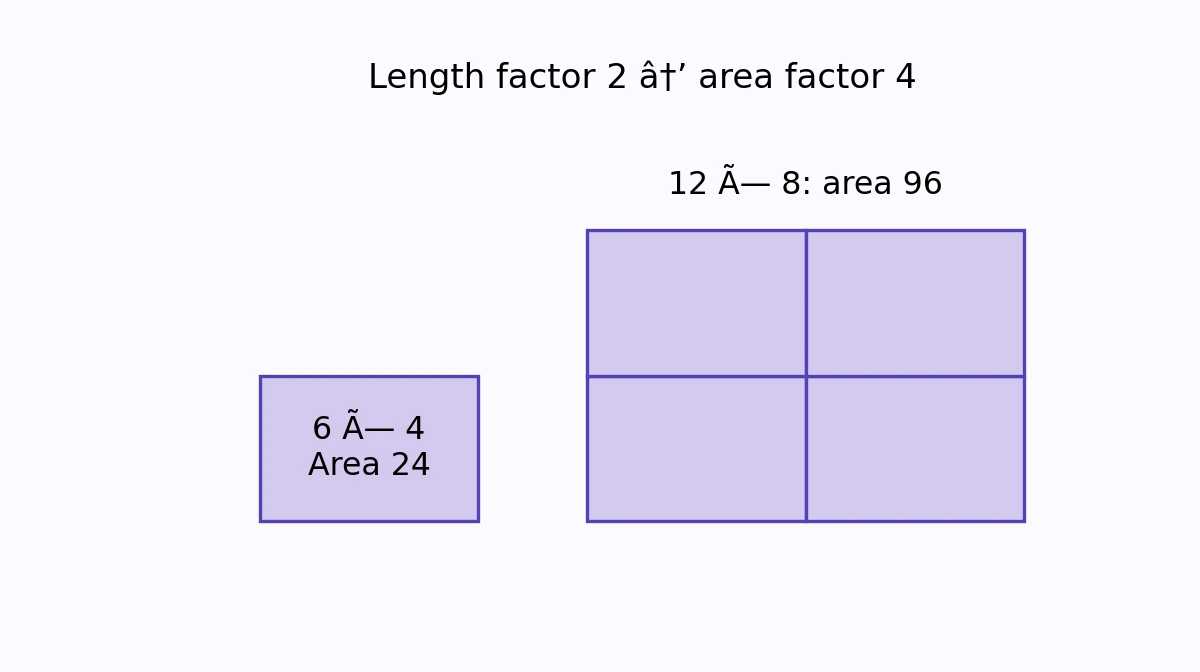
A rectangular photo measures 4 inches by 6 inches. Enlarge both dimensions by a factor of two and it becomes 8 inches by 12 inches. The length and width double, but the area grows from 24 to 96 square inches.
Two independent length changes multiply together. That is why a larger print can use far more paper even when its dimensions do not sound dramatically different.
Track both dimensions
The original area is \(4\times6=24\) square inches. The enlarged area is \((2\times4)\times(2\times6)\). Rearranging the multiplication gives \(2\times2\times(4\times6)\), or four copies of the original area.
Imagine placing four original photos in a two-by-two arrangement. Together, they fill the 8-by-12 rectangle. This picture explains the factor of four without relying on a formula alone.
If only the width doubled, while the height stayed at 4 inches, the area would merely double. “The image is twice as big” is therefore too vague: specify which dimensions changed.
The scale factor is squared
For a rectangle with sides a and b, multiplying every length by a positive factor k produces area \((ka)(kb)=k^{2}ab\). A factor of 3 gives nine times the area. A factor of \(\frac{1}{2}\) gives one quarter of the area.
The same area rule applies to geometrically similar plane figures. A circle’s area is \(\pi r^{2}\), so doubling its radius multiplies its area by four. Its circumference, \(2\pi r\), only doubles. Boundary length and filled area measure different things.
Similarity matters. A photo stretched by different horizontal and vertical factors changes shape. If those factors are p and q, its rectangular area changes by pq, rather than by one common scale factor squared.
Start with area when that is the target
Suppose you want twice the area while preserving the shape. The required length factor satisfies \(k^{2}=2\), so \(k=\sqrt{2}\approx1.4142\). Each dimension increases by about 41.42%, not 100%.
A 10% increase in both dimensions is another useful check. The area factor is \(1.1^{2}=1.21\), giving a 21% increase. Applying the two changes successively explains the extra percentage point.
Keep the units attached
Lengths use inches, centimeters, or another linear unit. Areas use square units. A change in the number of units is also a scale change: 1 square meter contains 10,000 square centimeters because each meter contains 100 centimeters.
Before budgeting material or comparing a diagram, decide whether the quantity is length, area, or volume. Review the relevant formulas in MathBlog’s area guide. The exponent follows the number of independent dimensions being scaled.