Numerically, 1.20 and 1.2 are equal. The extra zero does not make a length larger or change the rules of arithmetic. In a measurement record, however, that zero can help communicate how someone chose to report the value.
The important word is “can.” A zero might preserve a reporting convention, or it might have been added by a spreadsheet format. You need the context before turning its presence into a claim about a measuring instrument.
What the extra zero conventionally signals
Under the usual significant-figure convention for reported measurements, trailing zeros after a decimal point count. These three ways of writing a length therefore communicate different last reported places:
| Written value | Significant digits | Last reported place |
|---|---|---|
| 1.2 m | 2 | 0.1 m |
| 1.20 m | 3 | 0.01 m |
| 1.200 m | 4 | 0.001 m |
The table describes the notation. It does not establish that the last digit is correct, that the instrument detects changes of that size, or that a certain percentage of repeated measurements would fall nearby. Adding a zero to an old reading collects no new evidence.
A rounding bin is an assumption, not a calibration
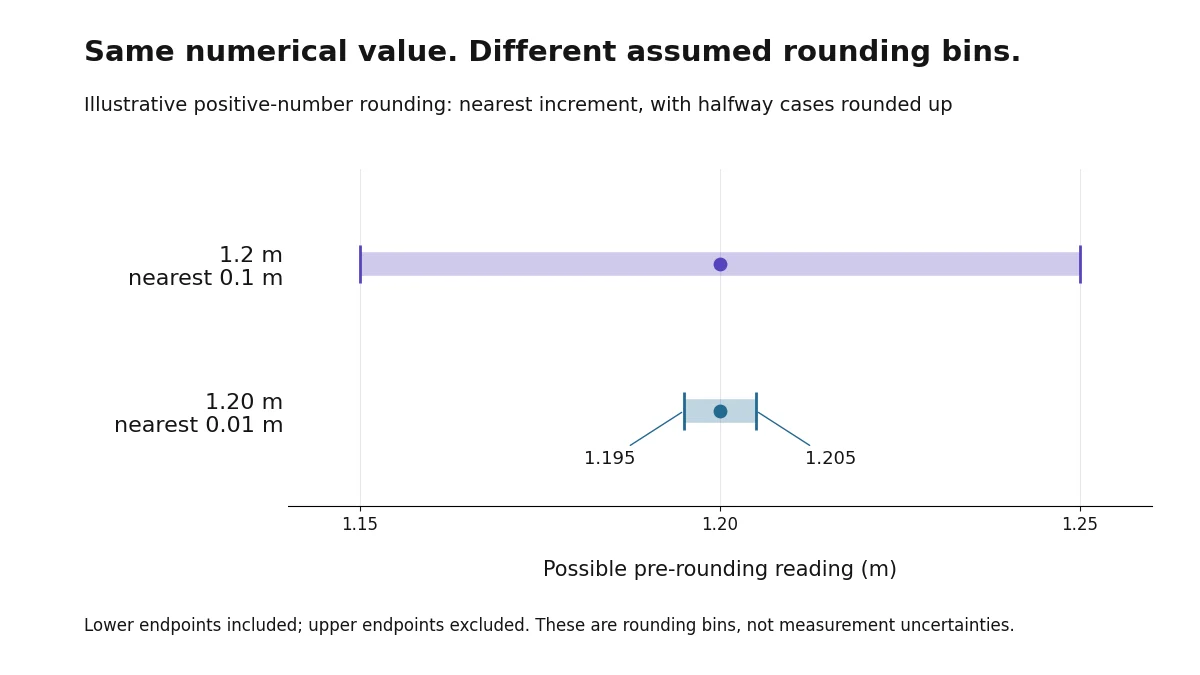
To make the difference concrete, suppose positive readings are rounded to the nearest stated increment, with exact halfway cases rounded up. A report of 1.2 m then represents pre-rounding readings from 1.15 m up to, but not including, 1.25 m. A report of 1.20 m represents 1.195 m up to, but not including, 1.205 m.
A pre-rounding reading of 1.204 m becomes 1.2 m at one decimal place and 1.20 m at two. A reading of 1.236 m also becomes 1.2 m at one decimal place, but becomes 1.24 m at two. Those examples explain what extra recorded detail can retain when the rounding procedure is known.
It would be a mistake to conclude that every measurement written 1.2 m has uncertainty \(\pm0.05\) m. We introduced a specific rounding model. Real uncertainty can also involve calibration, the method, environmental effects, and other information. A consistently biased instrument can still produce carefully formatted readings.
Digits, resolution, precision, and accuracy are different
NIST’s measurement handbook warns that the number of displayed digits does not establish an instrument’s resolution. The physical measurement system has to detect and faithfully indicate small changes; an extra display position is not enough to show that it does.
Measurement precision concerns agreement among repeated measurements under stated conditions. Accuracy concerns agreement with the quantity being measured. Neither is demonstrated by the typography of a single result. A complete uncertainty statement also needs more context than the last decimal place.
For that reason, do not “improve” a source report by changing 1.2 to 1.20. If you are copying a measurement record, preserve meaningful original formatting and its supporting metadata. If you are merely styling a price column to two decimal places, describe that as formatting rather than a new measurement.
Changing units can hide the distinction
The conversion from meters to centimeters is exact: 1 m equals 100 cm. But writing both 1.2 m and 1.20 m as 120 cm can conceal the intended reporting convention. Scientific notation makes it visible: \(1.2\times10^{2}\) cm carries two significant digits, while \(1.20\times10^{2}\) cm carries three.
The numerical length remains the same. What differs is the information a reader may infer from the record. A plain 120 cm needs context if its trailing zero is supposed to communicate a particular reported place.
Keep the meaning with the number
A numeric field alone may not retain the distinction between 1.2 and 1.20. When that distinction matters, keep the original recorded text or a separate reporting-increment field alongside the numeric value and unit. Document an actual uncertainty separately, including what the statement means.
This lets you calculate with the value while preserving how it was reported. Our guide to rounding explains how digits change under a chosen rule. The recording convention explains why you chose that rule in the first place.
Further reading
- NIST/SEMATECHResolution of a measurement systemWhy display digits alone do not establish physical measurement resolution.
- JCGM/BIPMMeasurement accuracyThe metrology definition distinguishes accuracy from the notation of a result.
- JCGM/BIPMMeasurement precisionPrecision is about agreement among repeated measurements under specified conditions.