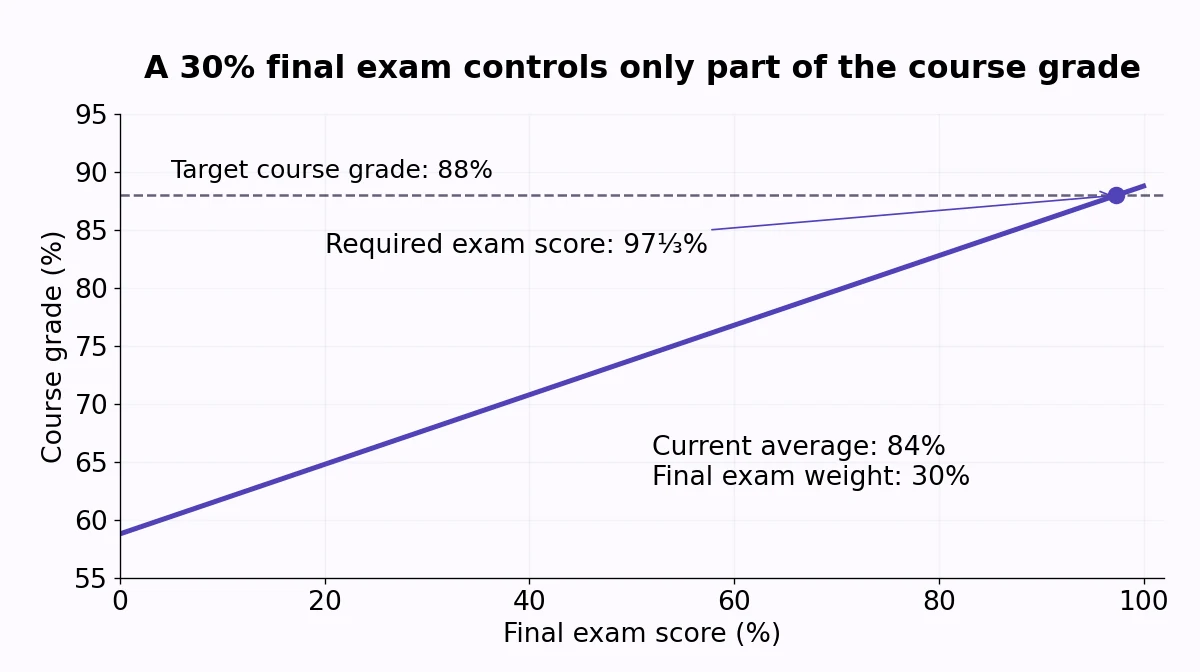
You have an 84% average before the final exam and want to finish the course with 88%. If the exam is worth 30% of the course grade, scoring 88% on it will not be enough. You need 97⅓%, assuming the rest of the grade stays fixed.
The important number is the exam’s weight. A strong final can improve your average, but it only controls its assigned share of the course grade. A short calculation shows both the score you need and whether the target is still possible.
Start with the grade the final does not control
If the final is worth 30%, completed coursework accounts for the remaining 70%. Its contribution to the final course grade is therefore 84 × 0.70 = 58.8 percentage points.
That 84% must be the average for completed nonfinal work, normalized to that portion of the course. A gradebook that already counts a missing final as zero may display a different number. Check the syllabus and what the displayed average includes before using it.
Write the unknown exam score as F. The desired course grade then gives this equation:
88 = 58.8 + 0.30F
Subtract 58.8, then divide by 0.30: F = 29.2 / 0.30 = 97⅓. The weighting follows the same multiply-and-add idea used in a weighted course-grade example in Google’s documentation; these particular values are our own example.
The formula for another target
Let C be the current nonfinal average, T the target course grade, and w the final’s weight written as a decimal. For a 30% exam, w is 0.30.
Required final score = [T − C(1 − w)] / w
The formula assumes 0 < w ≤ 1, a common percentage scale, no remaining work besides the final, and a fixed weighted-average grading rule. A course with replacement exams, dropped scores, extra credit, or a required minimum exam score needs its actual policy applied separately.
| Target course grade | Required final score |
|---|---|
| 85% | 87⅓% |
| 88% | 97⅓% |
| 90% | 104% |
A result over 100% is useful information
For the 90% target, the calculation gives 104%. On an exam capped at 100%, that target cannot be reached under these assumptions. Even a perfect final would produce 58.8 + 0.30 × 100 = 88.8%.
A negative required score means that even zero on the final would meet the numerical target under the model. It does not override an attendance rule or a separate requirement to take or pass the exam. At the other extreme, if the final is worth 100%, completed coursework contributes nothing to this particular formula.
Do not round a minimum down
For the 88% target, 97.33% is slightly below the exact threshold. If exam scores can be recorded to hundredths of a percentage point, 97.34% is the first such score that meets it. If only whole percentage scores are possible, you need 98%, which gives a course grade of 88.2%.
An exam scored in points may allow a different set of percentage scores. Convert the required percentage to points, then choose the next attainable score at or above it. Any course rounding policy remains a separate rule.
Finally, substitute your proposed score back into C(1 − w) + Fw. That quick check catches a misplaced percentage or a current average that was entered on the wrong scale.