A traveler covers 24 miles at 30 mph, then another 24 miles at 60 mph. The two distances are equal, so it is tempting to average the speeds and answer 45 mph. The actual average is 40 mph.
The slower part lasts longer. To find an average speed, add the distances and divide by the total elapsed time, rather than giving each displayed speed an equal vote.
Count the hours before averaging the speeds
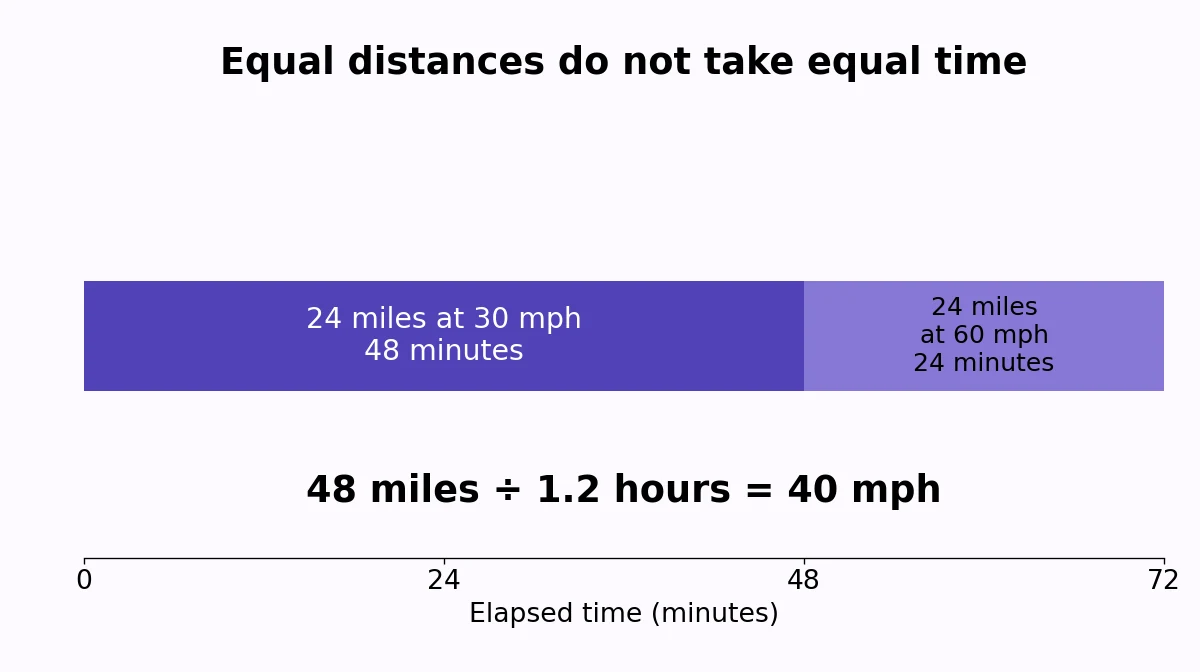
The first leg takes 24 / 30 = 0.8 hour, or 48 minutes. The second takes 24 / 60 = 0.4 hour, or 24 minutes. The total is 48 miles in 1.2 hours:
Average speed = 48 / 1.2 = 40 mph.
OpenStax defines average speed using distance and elapsed time. In this example, the traveler spends twice as long at 30 mph as at 60 mph. An arithmetic mean of the two speeds hides that difference.
| Leg | Distance | Speed | Time |
|---|---|---|---|
| First | 24 miles | 30 mph | 48 minutes |
| Second | 24 miles | 60 mph | 24 minutes |
| Whole trip | 48 miles | 40 mph average | 72 minutes |
When 45 mph would be the right answer
Change the question: travel for one hour at 30 mph and one hour at 60 mph. The distances are now 30 and 60 miles. The trip covers 90 miles in two hours, giving 45 mph.
Equal time at each speed makes the arithmetic mean appropriate. Equal distance generally does not. This is the distinction explored in Underground Mathematics’ comparison of average speeds.
You can also calculate our original trip as a time-weighted arithmetic mean: (30 × 0.8 + 60 × 0.4) / (0.8 + 0.4) = 40. The weights are hours, rather than the number of legs.
The equal-distance shortcut is a harmonic mean
For two equal positive distances traveled at positive speeds u and v, the average speed is:
2 / (1/u + 1/v) = 2uv / (u + v).
With 30 and 60 mph, this becomes 2 × 30 × 60 / 90 = 40 mph. The expression is the harmonic mean of the speeds. It follows by writing each leg’s time as distance divided by speed; it is not a separate rule about driving.
Use the shortcut only when the distances are equal. For unequal distances, return to total distance divided by total time. A positive-distance leg cannot be completed at a constant speed of zero, so zero is not a valid input to this particular shortcut.
Decide whether the clock includes stops
If the original traveler also stops for 12 minutes, the total elapsed time becomes 84 minutes, or 1.4 hours. The overall average is then 48 / 1.4 ≈ 34.29 mph. The moving average remains 40 mph if the stop is excluded.
Neither label should be left implicit. A journey summary needs to say which time interval it covers.
Average speed also differs from average velocity. On an out-and-back journey that finishes where it started, displacement is zero, so average velocity is zero over the complete journey. Total distance is still positive, so average speed is positive.
The reliable starting question is therefore simple: how much distance was covered, and how much time belongs in the denominator?