Calculate a weighted average from values and their corresponding weights. Use weights to represent counts, relative importance, or shares of a total. A separate final-exam mode finds the exam score needed to reach a target course grade.
Use the same scale for every value and one consistent scale for the weights. The tool does not decide which weights are appropriate for your question.
Calculate a weighted average
Maximum 5,000 pairs, 200,000 characters per list, 100 coefficient digits per value and input exponents from −100 to 100. Entered decimals are retained exactly for arithmetic; averages are rounded only for display. No entries are silently discarded. Your input is not sent to a MathBlog calculation service.
How a weighted average is calculated
Multiply each value by its weight, add the products, and divide by the total weight:
Weighted average = Σ(value × weight) / Σ(weight).
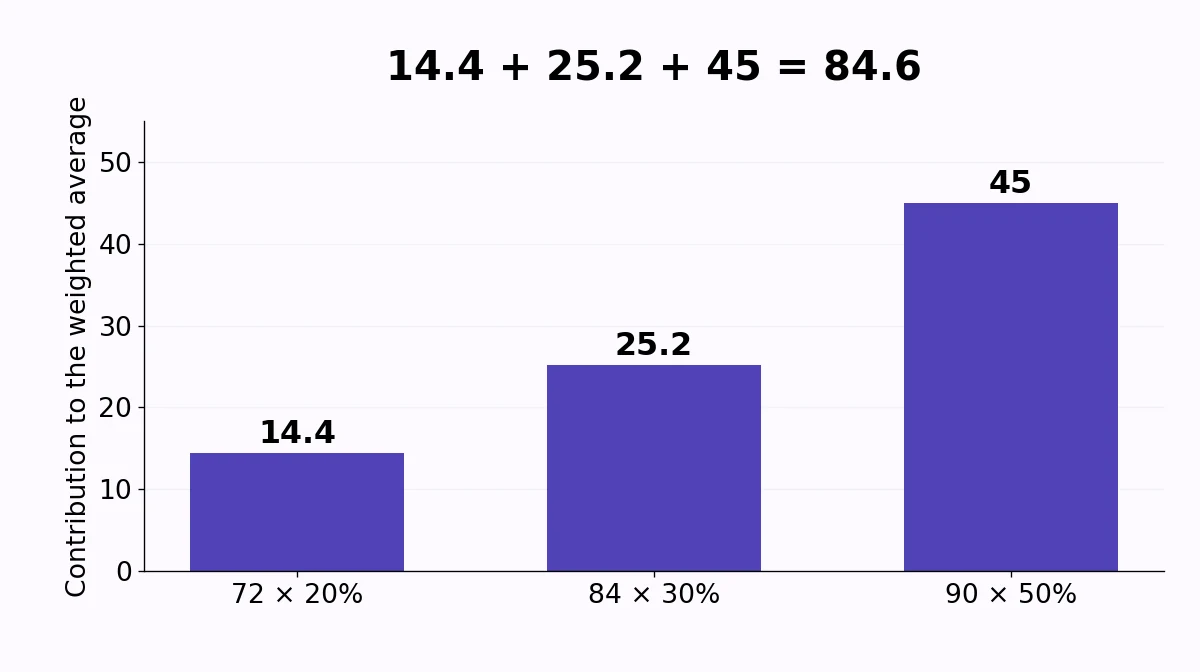
For values 72, 84, and 90 with weights 20, 30, and 50, the products are 1,440, 2,520, and 4,500. Their total is 8,460 and the total weight is 100. The weighted average is 84.6.
Weights do not have to total 100
Weights of 2, 3, and 5 give the same answer as 20, 30, and 50. Multiplying every weight by the same positive number changes both parts of the fraction by the same factor. You can therefore use counts or relative weights without first converting them to percentages.
If you choose to enter percentages, enter them consistently as percentage points, such as 20, 30, and 50. Do not mix 20 with 0.30 and 0.50. The latter entries use a different scale.
A zero weight excludes a value’s contribution. Negative weights and an all-zero set of weights are not accepted. Negative values themselves are allowed in weighted-average mode. Every value must have exactly one corresponding weight.
Final-exam mode
Enter the current average for completed nonfinal work, the target course grade, and the final’s percentage weight. All scores use a 0–100 percentage scale; the final weight must be above zero and no more than 100%.
Required final score = [target − current × (1 − weight)] / weight, where weight is the final’s fraction of the course grade.
With a current average of 84%, an 88% target, and a 30% final, the exact threshold is 97⅓%. If only whole percentage scores are possible, 98% is the first score that meets the target. A result above 100% is marked as unattainable on an exam capped at 100%; a nonpositive result means zero meets the modeled target.
Check your course policy separately. Dropped assignments, replacement scores, extra credit, point increments, and required minimum exam scores are outside this model. A gradebook average that already includes the missing final as zero is not the current average requested here.
Choose weights that match the question
For an average unit price, quantities may be appropriate weights. For combining group averages, use the number of observations represented by each group. For average speed, time is the weight in an arithmetic average of speeds; equal distances alone do not give equal time weights.
See why averaging percentages can go wrong for an example of choosing denominators carefully. The calculator can apply the supplied weights accurately while still answering the wrong question if those weights were chosen incorrectly.