Enter a list of numbers to calculate its mean, variance, and standard deviation. Choose Sample to divide squared deviations by n − 1, or Population to divide by n. The worked calculation shows the observations used and how the result is obtained.
Keep every value in the same units. Use spaces or new lines to avoid ambiguity when entering large numbers.
Calculate standard deviation and variance
Sample mode needs at least two observations; population mode accepts one. Maximum 10,000 entries, 200,000 input characters, 100 digits per value and input exponents from −100 to 100. Variance uses exact entered decimals; displayed values and square roots are rounded. Your data stays in this browser.
How to enter your data
Type or paste decimal numbers separated by spaces, new lines, semicolons, or commas. Use a decimal point and omit thousands separators: enter 1000, not 1,000. Scientific notation such as 2.5e3 is accepted. Do not include labels, unit symbols, spreadsheet headers, or missing-value markers.
The tool supports up to 10,000 observations and 200,000 input characters. Each value may have up to 100 coefficient digits and an entered exponent from −100 to 100. Invalid entries stop the calculation; the tool does not silently drop them.
Sample or population?
Choose Sample when the observations are a sample used to estimate a broader population’s variability. At least two values are required. Choose Population when the list contains every value in the population you intend to describe. A population of one value has zero variance and standard deviation.
The two modes use the same mean and squared-deviation total. Only the divisor changes. Our standard deviation guide explains the formulas in more detail.
A worked example: 4, 6, 6, 8
The mean is 6. Subtracting 6 gives −2, 0, 0, and 2; squaring and adding gives a total of 8.
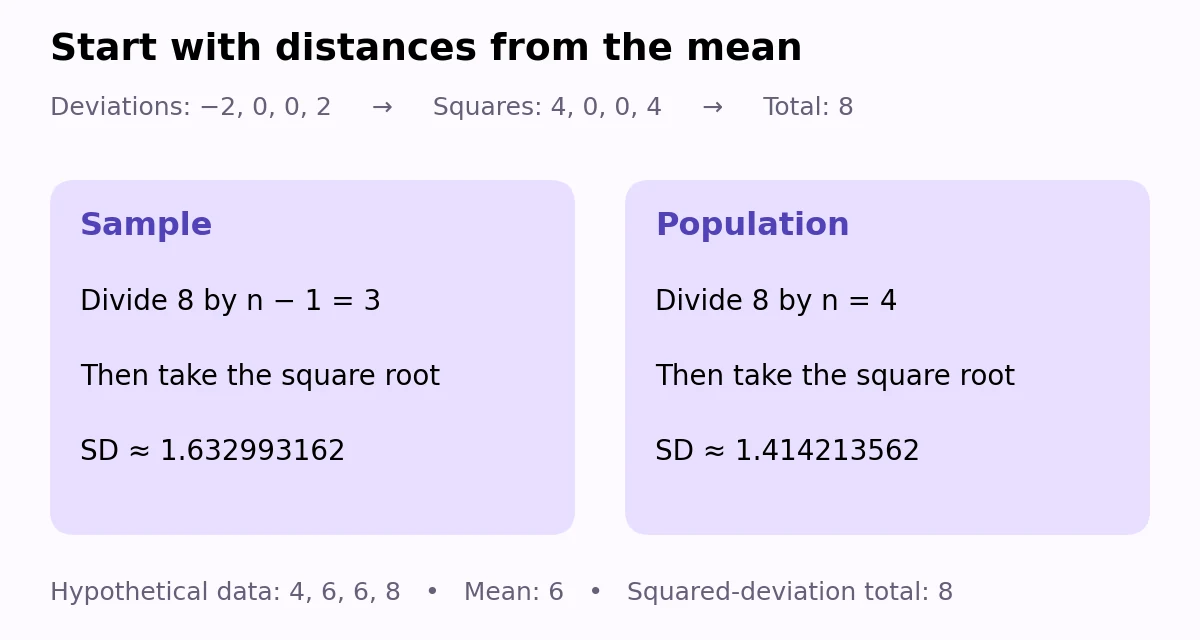
- Sample: variance = 8/3 ≈ 2.666666667; standard deviation = √(8/3) ≈ 1.632993162.
- Population: variance = 8/4 = 2; standard deviation = √2 ≈ 1.414213562.
Standard deviation has the same units as the inputs. Variance has squared units. If every value is identical, all deviations are zero and both results are zero whenever the selected mode has enough observations.
Precision and the calculation steps
Choose 6, 10, or 15 significant digits for the displayed results. Entered finite decimals are retained exactly for the mean, squared-deviation total, and variance; only displayed values and square roots are rounded. A displayed mean may therefore conceal small differences that the calculation still retains. Very large or very small results use scientific notation.
For long lists, the worked table displays the first eight observations, while the results and totals use every accepted entry. The calculator describes an unweighted list. It does not calculate grouped-data estimates, confidence intervals, or standard errors.
Calculations run in your browser without sending the entered list to a MathBlog calculation service. This describes the calculator’s behavior, not the site’s separate analytics or advertising services.