Enter numerical observations to calculate their arithmetic mean, median, and mode. The results distinguish the middle position from the most frequent values and show every tied mode when values repeat.
Use spaces or new lines between values. A decimal point is supported, as is scientific notation. The calculator does not silently remove missing or invalid entries: correct them before calculating.
Calculate mean, median, and mode
Maximum 10,000 observations and 200,000 characters, with up to 100 coefficient digits per value and input exponents from −100 to 100. No observations are silently discarded. Calculations run in your browser; input is not sent to a MathBlog calculation service.
Worked example: two modes
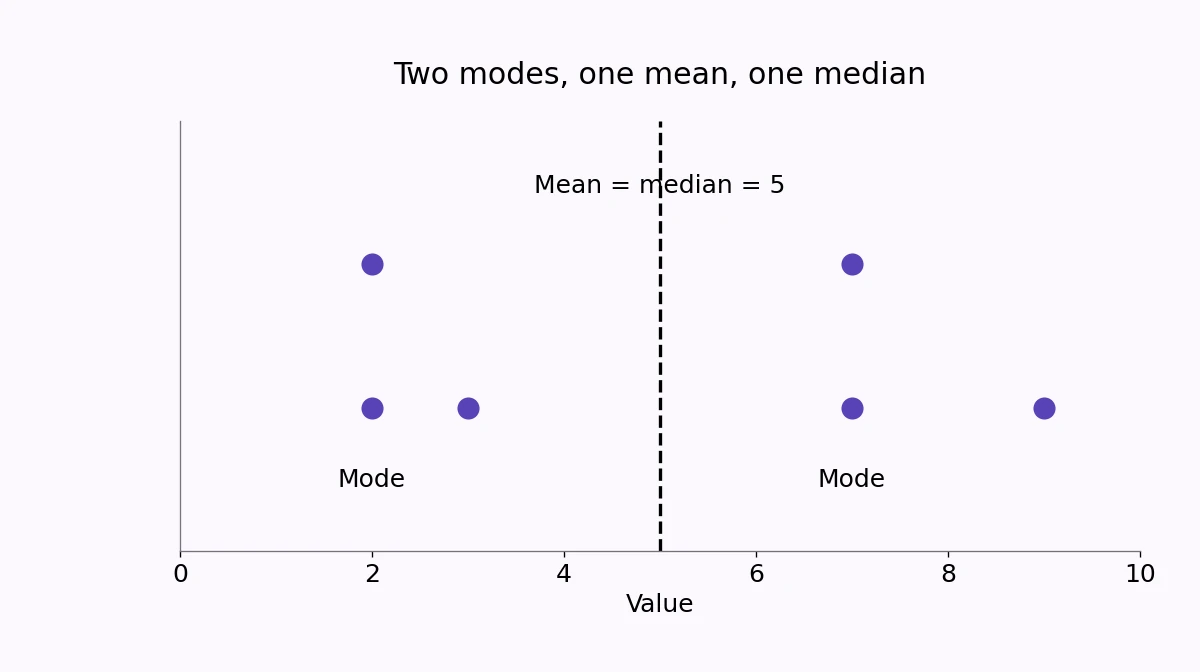
Try 2 2 3 7 7 9. There are six observations and their sum is 30. The mean is 30 / 6 = 5.
The list is already sorted. Its middle observations are the third value, 3, and the fourth value, 7. For an even count, average those two values: (3 + 7) / 2 = 5. That is the median.
Both 2 and 7 appear twice. No other value appears as often, so the dataset has two modes: 2 and 7. The fact that the mean and median are both 5 does not make 5 a mode; it does not appear in this list at all.
What each result means
The mean uses every numerical value. Large changes in an extreme observation can move it substantially. The median depends on ordered positions and is often useful when a few extreme values make the mean unrepresentative of the middle.
The mode answers a frequency question. It can identify several equally frequent values. This tool reports no mode when no value repeats, including a one-observation dataset. Other software may use a different convention; compare definitions before treating different labels as a calculation error.
Decimals, order, and displayed precision
Input order does not change these summaries. Numerical equivalents such as 0.1 and 0.10 are counted together, while genuinely different numbers remain distinct even if a short display would round them alike. Mode labels retain one representation entered for that number.
Mean and median use exact arithmetic for entered finite decimals. Choose up to 15 significant digits for their displayed summaries. An optional calculation explanation also gives exact fractional mean and median values. No intermediate mean is rounded before the median or frequency calculation.
Choose data that answer the same question
These calculations treat each entry as one equally weighted observation. A list of class averages with different class sizes needs weights instead; repeating an average once does not represent all the underlying students.
Numerical category codes need care, too. If 1, 2, and 3 merely name unrelated groups, their arithmetic mean is not meaningful. The mode can summarize categories, but this particular calculator accepts numerical input only.