Find the exact least common multiple of one or more positive integers. Enter the numbers as a list separated by spaces, new lines, or semicolons. The result includes the number of inputs and their greatest common divisor.
This calculator uses the positive-integer definition of LCM. It rejects zero, negative values, fractions, and decimal inputs rather than silently applying a different convention.
Find a least common multiple
Enter 1–100 positive whole numbers, each at most 30 digits. Separate them with spaces, new lines, or semicolons. Commas, zero, negative numbers, and decimal values are not accepted. Maximum 8,000 characters.
Calculations run in your browser. Your entries are not sent to a MathBlog calculation service. Exact results and approximate values are labeled separately.
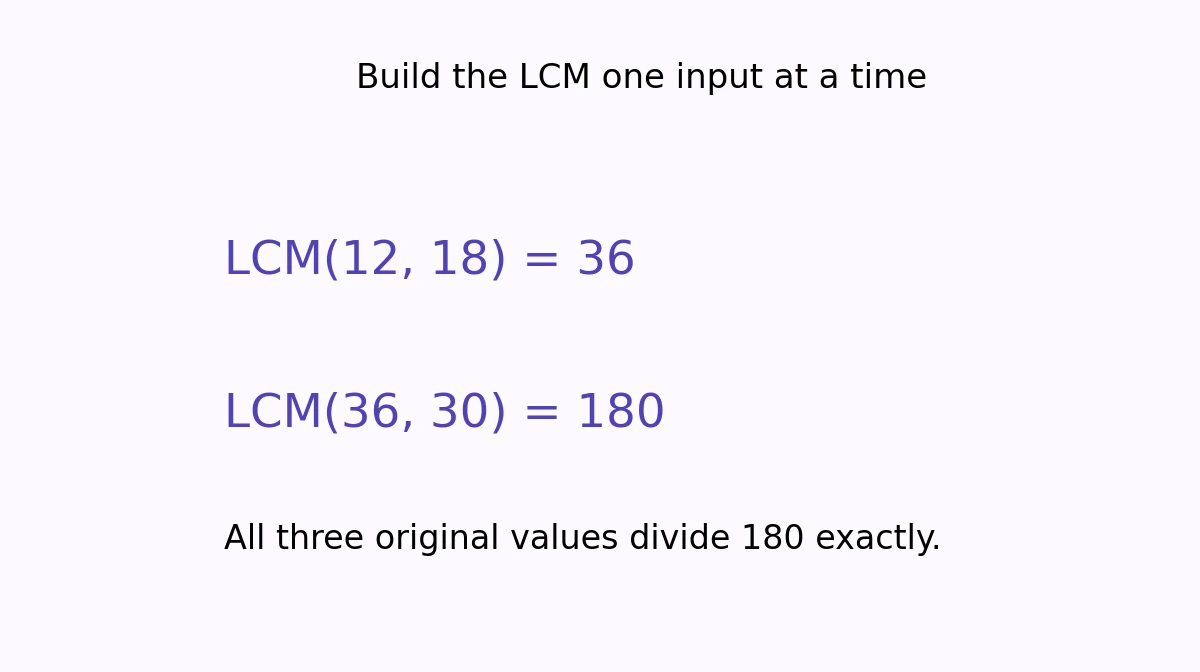
Example: 12, 18, and 30
The first pair has greatest common divisor 6. Their least common multiple is \(\frac{12}{6}\times18=36\). Combining that result with 30 gives \(\operatorname{GCD}(36,30)=6\) and \(\operatorname{LCM}(36,30)=\frac{36}{6}\times30=180\).
Check divisibility: \(\frac{180}{12}=15\), \(\frac{180}{18}=10\), and \(\frac{180}{30}=6\). Each quotient is an integer. The pairwise construction also establishes minimality; simply finding a divisible value would not establish that it is the least one.
How the tool calculates
For each pair of positive integers a and b, it finds their greatest common divisor with the Euclidean algorithm, then calculates \(\frac{a}{\operatorname{GCD}(a,b)}\times b\). The current result is combined with the next input until the entire list has been used.
Exact integer arithmetic avoids rounding large whole numbers to nearby floating-point values. The calculation steps show at most the first 10 intermediate combinations. The final result still includes every accepted input.
Input limits
Enter from 1 to 100 positive integers, with at most 30 digits each and 8,000 characters in the full list. Commas are not separators here: type 1000 1500, not 1,000 1,500. Repeated values are allowed and do not change the LCM.
With one input, the result is that number itself. If one number divides another, the larger number is already their LCM. Including 1 leaves the result unchanged.
What an LCM can tell you
For two exact repeating schedules that start together, the LCM of their periods gives the next simultaneous positive event time. Convert both periods to a common integer unit first. Different starting offsets require additional reasoning.
A denominator LCM also provides a least common denominator for fractions. For the definitions and a prime-factor explanation, use MathBlog’s arithmetic reference. A greatest common divisor and a least common multiple are related, but they are not interchangeable answers.