Add, subtract, multiply, or divide two fractions and get a simplified exact result. Enter each numerator and denominator separately. The tool also gives a mixed-number form when appropriate and a clearly labeled decimal approximation.
Use whole-number entries, including negative numerators or denominators. Enter an improper fraction rather than a mixed number: for example, use numerator 7 and denominator 3 for \(2\frac{1}{3}\).
Calculate with two fractions
Enter four whole numbers, with up to 100 digits each. Denominators must be nonzero. Division also requires a nonzero second numerator. No decimal or mixed-number input.
Calculations run in your browser. Your entries are not sent to a MathBlog calculation service. Exact results and approximate values are labeled separately.
Adding and subtracting fractions
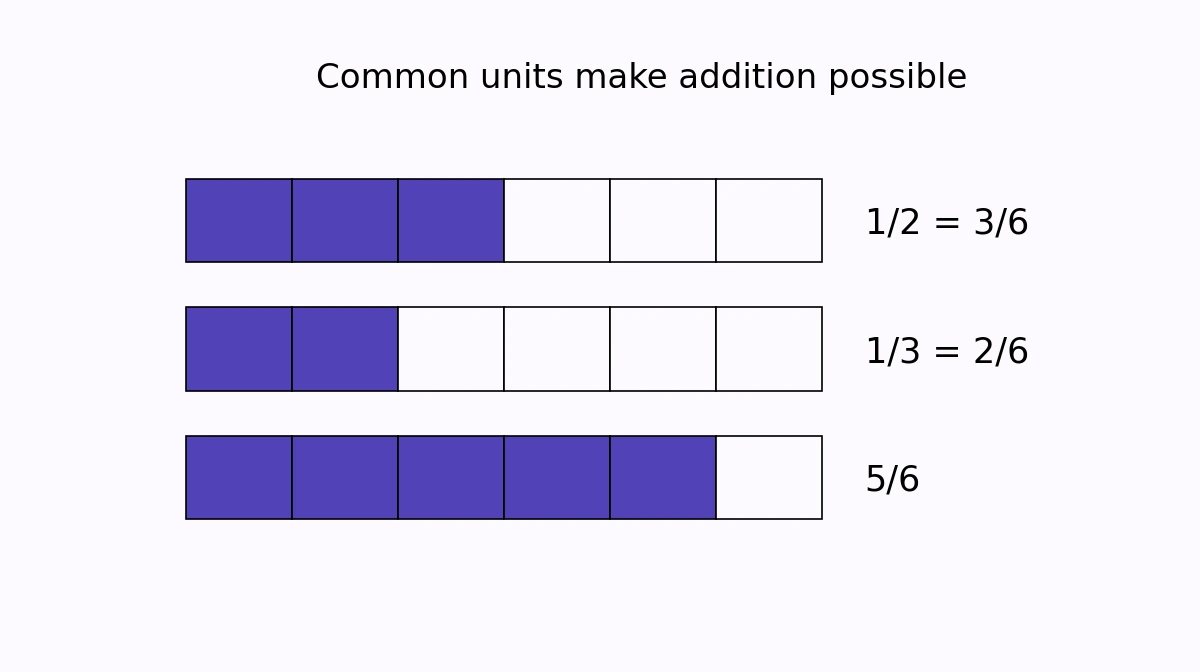
Equivalent fractions make it possible to combine quantities expressed in different fractional units. For \(\frac{1}{2}+\frac{1}{3}\), a common denominator is 6. Rewrite the fractions as \(\frac{3}{6}\) and \(\frac{2}{6}\), then add their numerators: \(\frac{5}{6}\).
For \(\frac{a}{b}+\frac{c}{d}\), the unreduced expression is \(\frac{ad+bc}{bd}\). Subtraction replaces the plus sign with a minus sign. The tool reduces the result by the greatest common divisor and keeps the denominator positive.
Multiplication and division
To multiply, multiply the numerators and multiply the denominators. Thus \(\frac{3}{4}\times\frac{2}{3}=\frac{6}{12}=\frac{1}{2}\). You do not need a common denominator first.
To divide by a nonzero fraction, multiply by its reciprocal. For \(\frac{3}{4}\div\frac{2}{3}\), calculate \(\frac{3\times3}{4\times2}=\frac{9}{8}\). The mixed-number form is \(1\frac{1}{8}\), and the decimal is \(1.125\).
Zero and negative values
A denominator of zero is never accepted. A zero numerator is allowed unless that fraction is the divisor. For example, \(\frac{0}{5}+\frac{2}{3}\) equals \(\frac{2}{3}\), but \(\frac{2}{3}\div\frac{0}{5}\) is undefined.
A negative denominator is moved into the numerator’s sign. Both \(\frac{1}{-2}\) and \(-\frac{1}{2}\) represent the same value. A mixed number such as \(-1\frac{1}{2}\) means the negative of the entire mixed quantity, or \(-\frac{3}{2}\).
Exact output and its limits
Each integer field accepts up to 100 digits. Commas, decimal points, scientific notation, and mixed-number strings are rejected. The calculator uses exact integer arithmetic for fractions; only the decimal approximation is rounded, to at most 12 significant digits.
A repeating decimal does not become a terminating exact value because a screen has limited space. Use the simplified fraction when exactness matters. See MathBlog’s fraction reference for the meaning of numerators, denominators, and equivalent fractions.