The discriminant of a quadratic equation \(ax^{2}+bx+c=0\) is \(D=b^{2}-4ac\), where \(a\ne0\). For real coefficients, its sign tells you whether the roots are two distinct real numbers, one repeated real number, or a nonreal complex conjugate pair.
Put the equation in standard form before identifying its coefficients. A term moved across the equals sign changes sign, which can change the discriminant.
What each sign means
| Discriminant | Roots | Real x-intercepts |
|---|---|---|
| D > 0 | Two distinct real roots | Two |
| D = 0 | One repeated real root | One |
| D < 0 | Two nonreal conjugate roots | None |
The quadratic formula is \(x=\frac{-b\pm\sqrt{D}}{2a}\). A positive D has two opposite real square-root choices. Zero makes both choices identical. A negative D requires complex numbers to express the square root.
Three examples with the same linear term
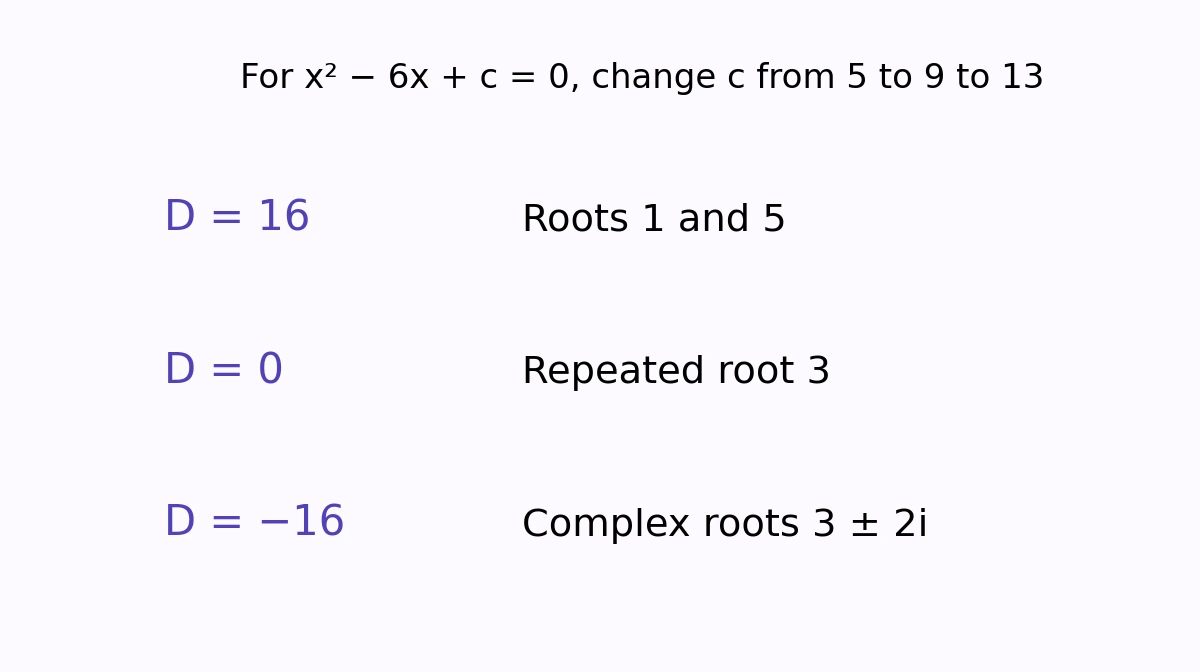
For \(x^{2}-6x+5=0\), \(D=36-20=16\). The roots are \(\frac{6\pm4}{2}\), giving 1 and 5.
For \(x^{2}-6x+9=0\), \(D=36-36=0\). The repeated root is \(\frac{6}{2}=3\). The factorization is \((x-3)^{2}=0\).
For \(x^{2}-6x+13=0\), \(D=36-52=-16\). Since \(\sqrt{-16}=4i\), the roots are \(\frac{6\pm4i}{2}=3\pm2i\). They are solutions over the complex numbers, even though the graph has no real x-intercept.
When roots are rational
For integer coefficients, a positive discriminant that is a perfect square gives rational roots. A positive nonsquare discriminant gives irrational roots. This convenient perfect-square test should be stated with its coefficient assumptions.
Zero gives the rational repeated root \(-\frac{b}{2a}\) when a and b are integers. A negative discriminant is outside the real-root cases.
Scaling an equation changes the number D
Multiplying every coefficient by a nonzero real factor k gives a discriminant \(k^{2}D\). Its magnitude changes, but its sign and the equation’s roots do not. For example, multiplying \(x^{2}-6x+5=0\) by 2 changes D from 16 to 64 while keeping the roots 1 and 5.
That matters when decimal coefficients are converted to integers for exact arithmetic. Compare equivalent equations by their roots and discriminant sign, not by assuming the discriminant’s numerical value must stay fixed.
Check the quadratic condition
If \(a=0\), the equation is not quadratic and this classification does not apply. Solve the remaining linear or constant equation separately. Review MathBlog’s quadratic formula guide for the complete solution process.