Practice subtraction as a relationship between quantities. Start with whole-number differences, then select larger numbers, decimals, or a signed extension when those skills are appropriate.
A manageable set leaves room to show a strategy and check it. Use addition to reverse a subtraction calculation, especially when regrouping or decimal places make the written steps harder to follow.
Use more than one way to check
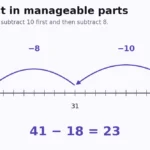
For 41 − 18, subtracting 10 and then 8 gives 23. Adding 23 and 18 returns 41, so the operations agree. A number-line model can also show the two leftward steps.
With decimals, align the decimal points before subtracting. With signed integers, preserve the order and the signs: subtracting a positive number can move a negative value farther left.
Choose an early whole-number level for first- or second-grade practice, decimal levels for later grades, and signed arithmetic for seventh-grade extension. The worksheet page provides the available levels and matching keys.
Standards and further reading