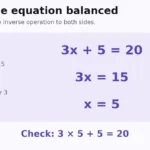
Use a variable to describe a value or a set of possible values. Begin with one-step equations and comparison inequalities, then move to two-step problems with signed numbers.
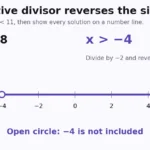
Show the operations used to isolate the variable, and check the result in the original statement. For inequalities, a number-line graph adds important information about the endpoint and the direction of all solutions.
Distinguish an equation from an inequality
The equation x + 7 = 19 has the solution x = 12. The inequality x > 4 describes infinitely many values, including 4.5, 5, and larger numbers; the endpoint 4 is excluded.
Sixth-grade starting levels use nonnegative one-step values and simple comparisons. Seventh-grade extensions include two-step problems and signed coefficients. Multiplying or dividing an inequality by a negative number reverses its direction.
Ask for a substitution check before looking at the key. A guessed answer is useful only when it satisfies the relationship that was actually given.
Standards and further reading