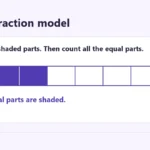
Keep the whole, the size of the parts, and the operation in view. Begin with equivalent fractions, then choose addition, subtraction, or multiplication at a suitable level.
A shared fraction page can contain several grade-specific options. Start with simple denominators for equivalence. For addition and subtraction, start with like denominators before moving to unlike ones. Save signed fractions for when the learner is ready.
Match the model to the question
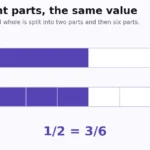
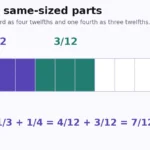
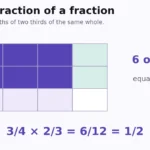
Equivalent fractions name the same amount: \(\frac{1}{2} = \frac{3}{6}\). Addition and subtraction require same-sized parts, as in \(\frac{1}{3} + \frac{1}{4} = \frac{4}{12} + \frac{3}{12} = \frac{7}{12}\). Multiplication can describe a fraction of a quantity: \(\frac{3}{4}\) of \(\frac{2}{3}\) is \(\frac{1}{2}\).
Ask the learner to estimate an answer before calculating. If two positive fractions are added, the sum should be larger than either addend. If a positive quantity is multiplied by a fraction below one, the product should be smaller.
Keep the intermediate work visible. Compare simplified forms to check whether answers are equivalent.
Standards and further reading